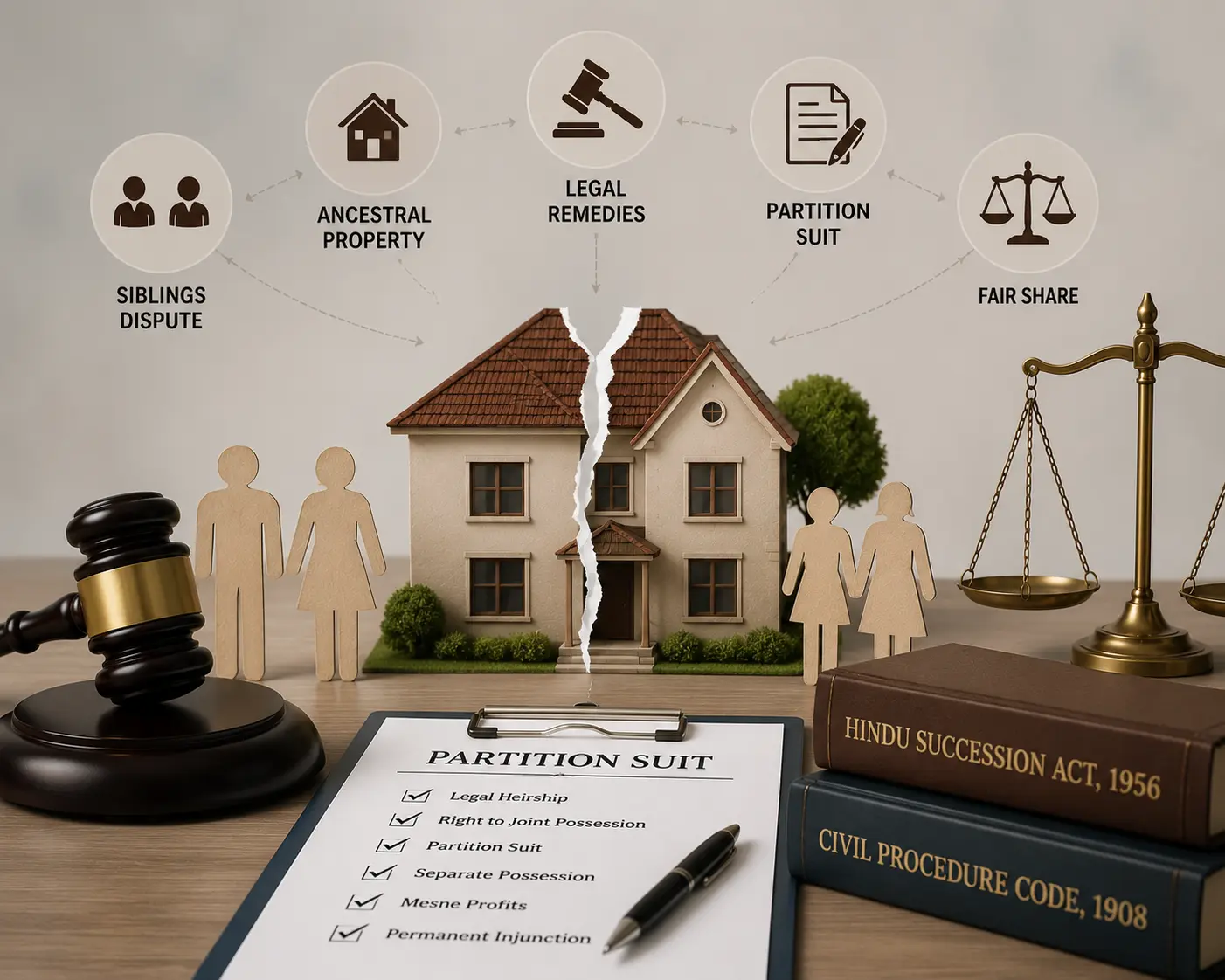
Disputes over family property seldom begin in the courts. Usually it’s a locked room, missing papers, one brother collecting rent, one brother saying “this is mine now,” or one sister being told that daughters shouldn’t ask for a share. By the time a case reaches a lawyer, years of silence, emotional pressure and informal promises have already damaged the relationship between family members. An ancestral property dispute among siblings is a fight between brothers, sisters, half-siblings or legal heirs about their share, possession, sale, rent, management or division of inherited family property. In India, the remedy may be in the form of legal notice, family settlement, injunction, declaration of share, partition suit and separate possession. Many people search for ancestral property dispute between siblings only when things become awkward. One sibling may be residing at the Delhi house. Another could be in Noida, Mumbai or Bangaluru. There can be someone who has the original sale deed. Someone else might have altered the electricity bill, mutation entry or property tax entry. A married daughter might be told to stay out of it. A younger brother may hear that the older brother has “taken care of everything”. That is where clear legal advice is important. Advocate BK Singh often explains this issue in simple words: first identify the nature of the property, then identify the legal heirs, then calculate the shares, then choose the least damaging remedy that still protects client’s rights. This guide explains the law, process, documents, risks, mistakes and practical remedies in a partition suit for property owners and families across Delhi NCR and India. Property values have changed the way families argue. A small ancestral house in Old Delhi, Karol Bagh, Shahdara, Lajpat Nagar, Ghaziabad, Noida, Faridabad, Gurugram, Meerut, Lucknow, Jaipur, Pune or Bengaluru may be worth several crores today. What appeared to be an old family asset can turn into the biggest financial security for the next generation. Thus, the disputes among siblings for ancestral property have become more serious in 2026. The amount of land available in cities is limited. Builder floors redevelopment is a common. Commercial rents are good. Parents frequently submit unclear papers. Families live on verbal agreements for years and then one person suddenly sells, mortgages, renovates or excludes others. Delhi NCR has a unique pattern. Many families own old residential houses, properties in illegal colonies, leasehold plots, DDA flats, land in Lal Dora, builder floors and inherited commercial shops and agricultural land in urbanizing belts. Each category has its own problems of documentation. Though the dispute may appear different from disputes over revenue records, family settlement papers or old possession based claims, it is a dispute over a registered sale deed in a partition suit. Sibling fights are also emotionally charged. You might not want to sue your brother or sister, but silence can cost you. One person can take rent for years. The property could be sold before the other heirs respond. A will can turn up unexpectedly. A power of attorney can be misused. Only one sibling can receive rent from a tenant. These facts matter in the case. For the readers of Property Lawyer Delhi the practical aim is not to create unnecessary litigation. Its purpose is to safeguard ownership, prevent unjust exclusion and progress the issue toward lawful settlement or court-sanctioned division. Advocate BK Singh says, “I usually tell families to act early, especially when property papers are being hidden, possession is being changed or a sale is being planned without consent. Inheriting property does not mean inheriting all property. A partition suit can be filed if the co-owners or the legal heirs are unable to divide the property amicably. Daughters have equal coparcenary rights in Hindu Mitakshara coparcenary property under Section 6 of Hindu Succession Act, 1956, as amended in 2005. A civil court can pass a preliminary decree declaring the shares and a final decree for division of the property. Mutation does not create ownership it is mainly to update municipal or revenue records. Delay may not always destroy a co-owner’s right, but it can undermine the evidence and urgency of relief. Family settlement is of use only if it is drafted, stamped, registered where required and properly implemented. Most ancestral property disputes between siblings begin with one question: “What is my share?The answer depends upon the religion of the parties, the source of the property, the family tree, the date of death, the nature of documents and existence of any valid will, gift, sale, release deed or family settlement. Property can be ancestral, self-acquired, co-ownership property, inherited property, joint purchase property or acquired property. These words are not synonymous. One of the most common mistakes that clients make is to call every old family property “ancestral”. Under Hindu law, ancestral property, strictly defined, generally means property inherited by a male Hindu from his father, grandfather, or great-grandfather in a Mitakshara coparcenary line, where rights by birth are conferred. Self-acquired property is different. If a father had purchased a house out of his own earnings then he may have been more free to sell, gift or bequeath the house during his lifetime, depending on the facts. For Muslims succession is generally opened at death . There is no such by birth style coparcenary in Hindu. For Christians and Parsis, inheritance is mostly regulated by the Indian Succession Act, 1925. Special rules may apply concerning tribal, customary or region-specific matters. And that’s why property lawyers don’t start with emotion. Advocate BK Singh first examines the title chain, family tree, death dates, possession history and documents before advising whether the right remedy is a legal notice, settlement discussion, injunction or partition suit. A partition suit is not just a demand for “my share.” It is a civil action in which the claimant asks the court to recognize shares, divide property where possible and grant relief related to separate possession or sale where physical division is not practical. Disputes relating to property in India between siblings generally involve succession law, civil procedure, property transfer law, registration law, court fee law and evidence. One family may require a Hindu Succession Act analysis. Another may require a challenge to a will. One sibling wants to sell the entire property and the third may require urgent injunctive relief. In India, Hindu intestate succession is regulated by the Hindu Succession Act, 1956. The Act provides for coparcenary property, male succession, female property and preferential right in certain cases. India Code identifies the Act as the principal law which codified the law of intestate succession amongst Hindus and it includes Section 6, Section 8, Section 14 and Section 22. There are many disputes in Hindu society regarding ancestral property due to section 6. After the 2005 amendment daughters became coparceners by birth in the same way as sons in a Mitakshara joint Hindu family. Nor does it mean that daughter has a right to any share in each and every property owned by her father. It means the nature of the property and the status of coparcenary has to be examined properly. Section 8 may be relevant in the case of a Hindu male dying intestate and the property devolving upon Class I heirs. Section 14 guarantees absolute property rights of a woman Hindu. Section 22 can be invoked in case one heir intends to transfer his right in the immovable property inherited and another heir claims for preferential right. The relevant provision depends on the facts. The Code of Civil Procedure, 1908 is important for partition proceeding. In many partition suits the court passes a preliminary decree in the first instance to determine the shares. Subsequently, in a final decree, the property is divided by metes and bounds, often with the aid of a local commissioner. Order XX Rule 18 CPC is generally referred to in this context. Partition Act, 1893 may be relevant where physical division is not convenient. In India Code, Section 2 of the Partition Act is referred to as empowering the court to order sale in lieu of partition in suits of partition. For example, one little residential floor might not be fairly physically divided between 6 siblings. In such cases, sale and distribution may be considered, depending upon the view of the court and the pleadings. If the share is sold, gifted or mortgaged by a sibling, The Transfer of Property Act, 1882 may be applicable. The Registration Act, 1908 is applicable to registered deeds, release deeds, sale deeds and partition deeds. The Indian Evidence Act has now been replaced by the Bharatiya Sakshya Adhiniyam, 2023 for matters relating to evidence in ongoing proceedings, while older evidence may continue to be assessed in accordance with procedural transition rules and facts of the case. Court fee and valuation rules vary from State to State. There could be different court-fee implications in Delhi, Uttar Pradesh, Haryana, Rajasthan, Maharashtra, Karnataka, Tamil Nadu and other States depending upon possession, valuation and relief claimed. Don’t take for granted that court fee for partition suit is same everywhere. The property lawyer also finds out whether the dispute is only about partition or it involves other reliefs such as declaration, cancellation of deed, permanent injunction, mandatory injunction, possession, mesne profits, rendition of accounts or challenge to mutation. This guidance is useful for siblings feeling left out of ancestral property, daughters not getting their share, brothers facing false claims, NRIs who have relatives controlling property in India, widows protecting their children's inheritance, and families where old parents died without a clear will. This advice may be necessary for a married daughter if her brothers tell her that she received gifts at marriage and should not claim property. A gift at a marriage does not ipso facto destroy a legal share. Where an elder brother keeps possession and rent, but refuses accounts, a son may require it. When someone tries to sell the whole property that was inherited without written consent from the other, it may be needed by a younger sibling. The problem for NRIs is something else. They might not know about a mutation changing, tenants moving, redevelopment talks starting, or a builder approaching the family. By the time they reach India, the property may be in the process of being sold. Online consultation is useful, but documents need careful verification. This guidance is also needed for the elderly. Sometimes a child takes the parents to the sub-registrar and gets them to sign a gift deed, will or release deed. Later siblings say they felt pressure, fraud or a lack of understanding. Since both family dignity and legal rights matter, these cases require sensitive handling. Business families need a different lens. Income can be generated from an inherited shop, factory plot, office floor or warehouse. Accounts become a big problem where one sibling owns the business and the property. You can’t forget about rent, license fee, good will and possession. Advocate BK Singh often tells his clients not to wait until the property is sold. Third-party rights lengthen, complicate, and increase the cost of resolving the dispute. A partition suit is a powerful tool, but it may not be the first step. Many sibling disputes can be settled by a well drafted legal notice, family meeting, mediation, written settlement, release deed, partition deed or sale arrangement. The right remedy depends on whether the other side is cooperative, dishonest, confused, or openly hostile. You can send a legal notice to clarify your share, ask for documents, object to illegal sale, ask for accounts and suggest settlement. It also provides a written record. This helps if years of WhatsApp messages and phone calls have not yielded any result. Family settlement is often the best way to go where parties want to steer clear of court. It can apportion property, allocate floors, note changes in money, resolve rent collection, clarify possession and prevent future claims. But casual settlement on plain paper can lead to a new dispute. Stamp duty, registration and drafting require due attention. Registered partition deed: Used when all the co-owners agree. It gives clarity and takes away the risk of future litigation. If one of the siblings gives up his share, either for consideration or voluntarily, a release deed can be executed. It is also possible to sell to one sibling if all parties agree on valuation. Where one sibling is selling, demolishing, constructing, creating tenancy, taking illegal possession or changing the nature of property, a civil injunction may be urgently required. Applications for temporary injunctions under Order XXXIX Rules 1 and 2 CPC are common in property litigation but relief depends on a prima facie case, balance of convenience and irreparable injury. It is necessary to file a partition suit, when the other party denies your share or a settlement could not be reached. If you need assistance that is document-led, then Property Lawyer Delhi’s legal services page is pertinent, as sibling property disputes quite often involve drafting that is court-ready, title review and litigation planning. And don’t file a partition suit lightly. The fate of the case will be decided by the good drafting. Poor pleadings, missing parties or wrong property description can cause later objections that are unnecessary. The first step is a thorough legal consultation. The lawyer asks who was the previous owner of the property, how he got it, when he died, who he left it to, whether there was a will, who has it and whether there is any sale, gift, mortgage or family settlement in existence. The second step is collecting documents. You may require certified copies from sub-registrar, municipal records, revenue records, electricity bills, property tax records, old rent agreements and mutation documents. When original papers are in the possession of one sibling, the plaint can refer to that fact. The third step is the share calculation and the family tree. For a Hindu family, the date of death and succession rules that apply are important. The calculation is technical with several generations. Shares may be affected by a predeceased son’s branch, a predeceased daughter’s branch, widow, mother, and children. Step four is to serve a legal notice, where appropriate. Some lawyers omit this but in many family disputes it helps. It gives the other side a chance to settle. It makes a clean record of demand. The fifth step is drafting of the plaint. The plaint shall specify the parties, property, source of title, family relation, share claimed, cause of action, status of possession, valuation, court fee and reliefs. The reliefs may be partition, separate possession, injunction, accounts and such other directions as may be necessary. The sixth step is to file in the competent civil court. Territorial jurisdiction is often associated with the place of location of immovable property. The pecuniary jurisdiction is determined by the value of the case and the local structure of the court. Seventh is summons and written statement. Defendants might deny ancestry, claim sole ownership, rely on a will, allege prior partition, say the suit is undervalued or argue that some parties are missing. The eighth step is temporary relief. If there is a threat of sale, construction, demolition, tenancy or dispossession you can apply for an urgent injunction. The ninth is proof. Parties prove title, relationship, possession, documents, conduct, rent, family arrangements and objections. Cross-examination can unmask false stories. Step Ten: Decree. Shares declared by preliminary decree. The final decree disposes of the property or makes further directions. Proceedings by the local commissioner may be required. Advocate BK Singh said the focus is on the early stages as a partition suit with poor facts on paper becomes difficult to repair later. In property cases, you win less on emotion and more on documents. Courts understand family pain but decrees are based on pleadings, proof and legal entitlement. Mutation is worth special mention. If one sibling gets mutation changed, many people panic. Mutation is important, but it is not the ultimate test of ownership. It could imply ownership or city recognition. It does not, in itself, defeat title. This is why mutation and land records assistance becomes important where siblings are fighting over revenue or municipal entries,” Advocate BK Singh, who usually asks his clients to get certified copies, said that in practice certified copies have more value in litigation than photocopies. In India, not all partition suits have a common time frame. Others come to terms after notice. Some are settled after interim injunctions. Some spend years wading through evidence and final decree proceedings. The speed depends on the documents, the number of parties, the workload of the court, the valuation, the work of the local commissioner and the conduct of the defendants. Limitations should be treated with care. Co-ownership disputes are not always regarded as simple money claims. Unless proved hostile denial, ouster or adverse conduct, possession by one co-owner may be taken as possession by all. However, delay can create serious practical problems. Papers go missing. Witnesses get killed. Properties for sale. Changes in building. Tenants move out. Family memories are unreliable. If there is a clear denial of share, a client should not wait. All these are decision windows: written denial, exclusion from possession, refusal to render accounts, forged documents, sudden mutation, proposed sale, redevelopment talks, bank mortgage or threat of dispossession. If one sibling has already sold more than his or her share, you need to get legal advice urgently. A buyer may assert a bona fide purchase. The court then looks at title, notice, possession and conduct. “Delay is the enemy of interim relief. Timing is also a matter of the court fee. The lawyer must figure out if the client is in joint possession, constructive possession or excluded possession. This may affect valuation and court fee under local law. Even if the client is not ready to file a suit, advocate BK Singh generally recommends early legal review. A one time review of a document can prevent a rushed case later on. The first error is to suppose that the oldest son will necessarily take over the family estate. Indian law does not confer ownership just because one sibling is older, lives in the house or handles papers. The second mistake is to believe daughters lose their share after marriage. The daughters have equal rights in the property of Hindu coparceners under the facts and valid prior transactions under Section 6. A third error is to equate mutation with ownership. "Mutation may be a fact but title depends on law and valid documents." The fourth mistake is signing family papers without reading them legally. A “no objection”, release, affidavit or settlement note can be used against the signatory later. The fifth mistake is not having accounts so one sibling can collect rent. History of rent can be a major claim in partition litigation. The sixth mistake is failing to make all necessary parties defendants. A partition suit may fail or get delayed if all the co-sharers, legal heirs or the affected transferees are not properly arrayed. 7th mistake Filing of only injunction suit where partition or declaration required Injunction alone may not decide ownership. The eighth mistake is to delay action as “family matter hai”. Many families have done this for 10 years. The property may have been sold, let or changed by this time. Mistake #9: Reliance on police complaints in purely civil ownership disputes Police can help with threats, trespass, forgery or violence, but division usually requires a civil remedy. The tenth error is emotional writing. Courts need facts, dates, documents, and reliefs. It takes more than anger to make a share. Advocate BK Singh keeps partition drafting fact-driven for judges need a clear map of ownership, not family bitterness. Ignoring a dispute between siblings over ancestral property can result in legal, financial and emotional damage. In some cases delay may not cause the legal right to be lost immediately, but the practical strength of the claim may be reduced. The biggest risk is the unauthorized sell. When one sibling sells the property or sells a greater share than is legally available the dispute can extend to buyers, banks, builders and tenants. Litigation is more expensive. The second risk is the change of ownership. The locks may be changed. Rooms can be demolished. Tenants are movable. One sibling may begin to lay exclusive claim. The third danger is document tampering. Old papers can be disposed of. It is possible to make a will. A family settlement may be claimed Signatures could be challenged. The fourth risk is loss of earnings. Commercial shops, rented floors and agricultural land can make money for years. Recovery might be more difficult if accounts are not called for. Fifth risk is family pressure. Many daughters and younger siblings are told to keep quiet to “save family respect” . Respect is not giving up your legal rights. The sixth risk is redevelopment without permission. Builders in Delhi NCR and other high-value markets approach one or two family members. If the other heirs fail to object in time, then the redevelopment arrangement can lead to a new dispute. Risk number seven is tax and compliance confusion. Selling, releasing, giving away, redeveloping and renting can create tax consequences. Legal and tax advice should be coordinated If you make a legal move calmly, you often avoid a bigger fight. Rarely does silence. If your share is denied, if papers are being kept secret, if rent is not shared, if the property is being sold, if the mutation is altered, if a will is presented, or if you are asked to sign a release deed without full explanation, you must see a property lawyer right away. Another trigger is unequal ownership. If one sibling takes over the entire property and says that others may only visit with permission, then the matter is no longer informal. It has to be checked legally. Consultation is also required in case the property is in the name of grandparent, father, mother, uncle, HUF, partnership firm, company or a deceased relative. Proof of ownership must be shown before any notice or suit. Before signing a family settlement a lawyer should also be consulted. Many people think settlement is cheaper so they don't use legal drafting. A bad settlement is not cheap. It may lead to another round of litigation. Delhi NCR families: Jurisdiction and document type matters. A DDA flat, freehold property, leasehold property, agricultural land, Lal Dora property, builder floor or commercial shop may need different handling. Advocate BK Singh can go through title chain, family tree, possession status and likely remedy before filing. This will save time and unnecessary claims. Ancestral property dispute between siblings Our property lawyer Delhi provides consultation, title review, legal notice, settlement drafting, injunction strategy, partition suit drafting, document collection and court representation support to clients. The first focus is on clarity. The team analyzes the property before issuing a notice or filing a suit to see if it is ancestral, inherited, self-acquired, jointly owned or already divided. This prevents false claims. The second focus is on documentation. The suit for partition should not be on assumptions. Family records, municipal entries, revenue papers, rent evidence, proof of possession and certified copies need to be carefully sorted out. Third, the selection of remedies. Sometimes a family settlement is required. Others need an immediate injunction. Some require declaration and cancellation of suspicious documents. Some require partition with accounts and intermediate profits. Advocate BK Singh’s document-led consultation provides practical advice to families in Delhi, New Delhi, Ghaziabad, Noida, Greater Noida, Gurugram, Faridabad, Meerut, Lucknow, Jaipur, Mumbai, Pune, Bengaluru, Hyderabad, Chennai, Kolkata, Ahmedabad and other Indian cities. If settlement is possible, the effort is to avoid needless acrimony. Where the other side is acting unfairly, the approach is firm and court ready. A related reading on family settlement vs partition suit can help families to realize the importance of written clarity before a dispute turns into a long litigation. The ancestral property dispute between siblings means the dispute about sharing, taking possession, collecting rent, selling, changing mutation, managing or partitioning of family property inherited from the ancestors. The remedy depends upon the source of property, religion, legal heirs, documents and whether any valid will, gift, sale deed or settlement. Yes, a married daughter is entitled to claim her lawful share where the law gives her rights of inheritance or coparcenary. After the 2005 amendment, under Hindu law, daughters have equal coparcenary rights with sons in Mitakshara coparcenary property, subject to the nature of the property, prior partition and the facts of the case. If shares of other co-owners exist, then one sibling cannot legally sell the whole of the joint property. A person can only transfer what he legally owns. Other siblings may seek injunction, declaration, partition or other civil remedies if a sale is threatened or completed beyond share. No. Mutation is not proof of ownership. Updates administrative records municipal or revenue records. Title must be established by means of valid documents, succession, inheritance, court orders and legal entitlement. A mutation may support a case but it does not replace proof of ownership. Family settlement is a voluntary agreement among the family members for division of property. Partition suit is a suit in court for declaration of shares and division of property. If the parties co-operate and the documents are clear, advocate BK Singh may suggest settlement as the first option. The timing depends on the court, the city, the number of parties, the complexity of documents, interim applications and evidence. In some cases, a settlement is reached early on. In case of will disputes, sale deeds, missing parties or proceedings of a local commissioner, others take longer. Yes, it could still be possible. The case can be supported by certified copies from sub-registrar, municipal records, revenue records, tax records, old litigation papers and other evidence. The plaint can say original documents are with other sibling. Yes, if property is jointly owned and one sibling collects rent, other co-owners may be able to claim accounts or share in income depending on facts. Rent logs, tenant information, bank deposits and notices are important evidence. Partition suit for immovable property is filed before the competent civil court having territorial jurisdiction over the property subject to pecuniary valuation and local court structure. Rules of Court fee and valuation differ from State to State. If your share gets refused, documents are hidden, a sibling threatens to sell, mutation gets changed, rent is not shared, a will suddenly appears or settlement papers are being forced, contact Advocate BK Singh. Review early to protect your rights before the dispute gets harder. A dispute between brothers over ancestral property is not just a legal case. A family problem, financial and emotional. But feelings do not replace documents. Oral promises will not substitute for a proper settlement. If the other side is changing records, selling property or collecting rent, silence will not protect your share. A partition suit may not be the first answer, but it is a serious remedy when fair division is impossible. IDENTIFY PROPERTY NATURE, LEGAL HEIRS, CALCULATION OF SHARE, DOCUMENTS, POSSESSION, LIMITATION RISK AND URGENT RELIEF BEFORE FILING. For families across Delhi NCR and India, the safest thing is simple: review documents early, don’t sign under duress, record objections in writing and choose the remedy that suits the facts. Advocate BK Singh & Property Lawyer Delhi can help with Consultation, Notice, Settlement, Injunction & Partition Suit Strategy. For urgent protection, read more about stay order and temporary injunction in a property dispute. The information in this article is general in nature and is not intended to be legal advice in respect of any specific case.Legal Remedies for Siblings in Dispute over Ancestral Property – Partition Suit
Table Of Contents
Why this issue is important in India, Delhi NCR and other cities in 2026?
Quick Facts Box
The Fundamental Legal Issue
Legal Aspects of Ancestral Property Dispute Between Brothers
Who Should Follow This Advice?
What are the Remedies Available Before Filing a Partition Suit?
Situation
Possible Solution
Sibling refuses to share papers
Legal notice, search of documents, suit with discovery-related steps
Sale or transfer risk
Suit for partition, objection to buyer, injunction to sell whole property
Rent collected by one heir
Accounts, mesne profits, share of rent, partition
Family broadly agrees
Family settlement or partition deed
Suspicious Will or Gift Deed
Declaration, Cancellation, Injunction, Probate-Related Advice as Applicable
Physical division is impractical
Partition suit with sale relief where legally possible
Procedure in a Partition Suit.
Form of Documents and Evidence
Documents useful for ancestral property dispute between siblings:
Timelines, Real-World Delays and Decision Windows
Typical Errors People Make in Sibling Property Disputes
Risks of Ignoring the Matter
When do you need to call a lawyer?
How a Property Lawyer Delhi Can Benefit You
Frequently Asked Questions
1. What is Siblings Ancestral Property Dispute?
2. Can a sister claim her share in ancestral property even after her marriage?
3. Can a brother sell ancestral property without the consent of others?
4. Mutation alone suffices to establish ownership in sibling property dispute?
5. What is the difference between family settlement and partition suit?
6. What is the time frame for a partition suit in India?
7. Can I file a partition suit if I do not have original property papers?
8. Can one sibling collect the rent from another?
9. Which court deals with suits for partition of ancestral property?
10. When to Approach Advocate BK Singh for an Ancestral Property Dispute?
Concluding Thoughts
Disclaimer
There's no reason for concern. There is no difficult-to-understand legalese.
Someone who has helped many people with the same problems gives you clear, honest advice. We want to make the legal process easy to understand and use for everyone.
Schedule Your Consultation