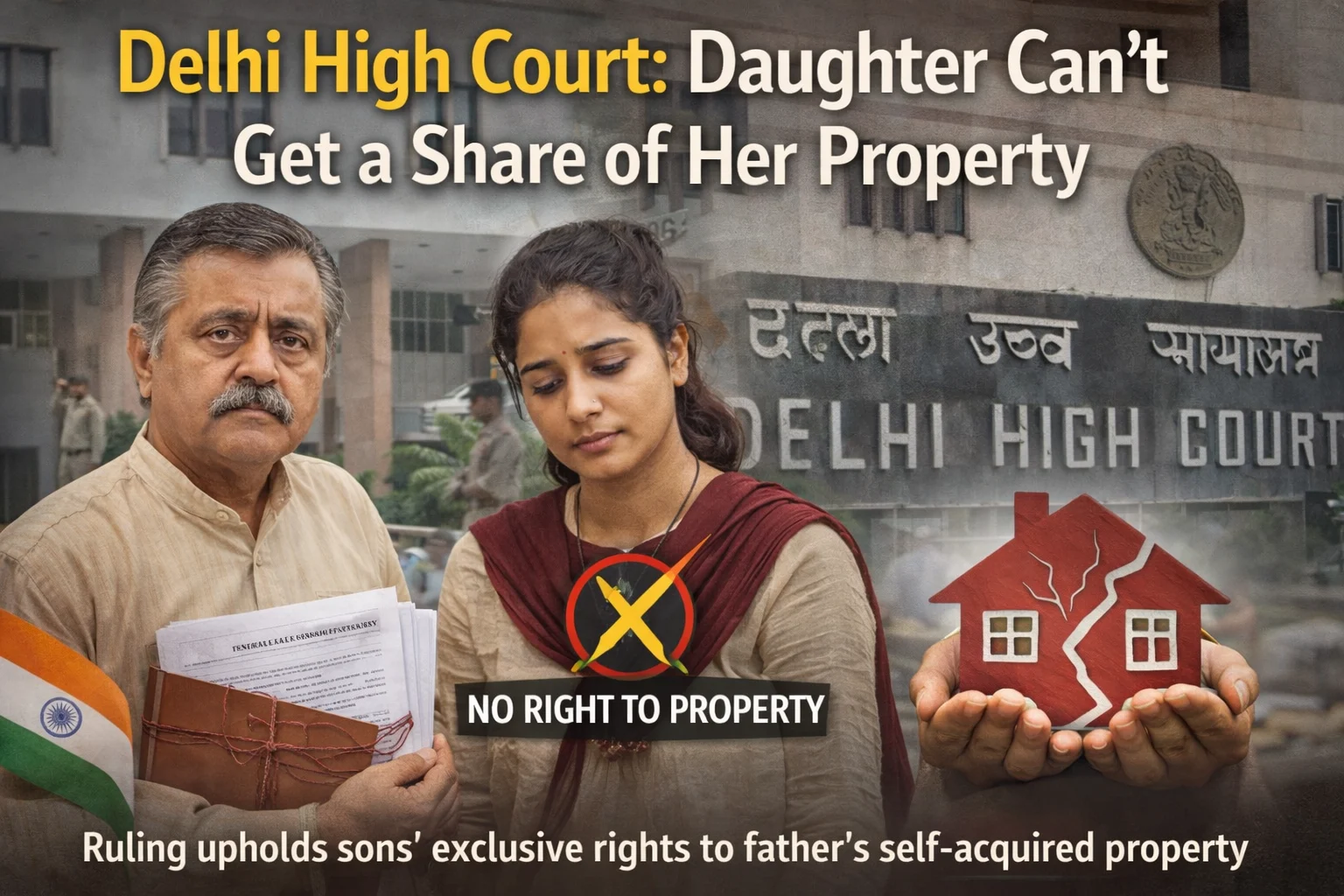
Delhi High Court Daughter Cant Get a Share of Her Property
This kind of headline spreads quickly because it hits a deep fear in Indian families. Many daughters read it and think their rights are being taken away, and many families use it to pressure women to be quiet about property issues. The truth is more specific in real life. A daughter can lose a claim not because daughters don't have rights, but because the claim is made on the wrong property, at the wrong time, or against the wrong type of legal heir.
Property Lawyer Delhi's Advocate BK Singh handles these kinds of disputes in a calm, document-first way. The goal is to keep feelings out of the legal situation and keep clients from wasting years on a case that was based on assumptions. One wrong case can ruin savings and peace for middle-class families. For small businesses, one shop or office that is in dispute can stop work and hurt their reputation. A good legal strategy is not a luxury; it's protection.
1. Why this type of judgment occurs
When the person making the claim doesn't have a legal right to the property at that time or in that category, the court will deny the claim. A lot of people think that every family property is an ancestral property or that every grandparent property automatically belongs to their grandchildren. The nature of the property and the line of succession determine how inheritance and partition work in law. The court may throw out the claim if it is based on a belief instead of the law.
One common reason is that the person who is claiming the share is trying to get it directly from a grandparent, even though the parent through whom the claim is made is still alive. Another reason is that the property is treated as the living owner's personal property, which makes the child's claim too early. Before filing, Property Lawyer Delhi makes sure that these mistakes don't happen by checking the family tree and title chain.
2. Why a daughter might not get a share of her grandfather's property while her father is still alive
A lot of families in Delhi think that a granddaughter automatically gets a share of her grandfather's property. But in a lot of cases of inheritance, the property goes to the deceased's children first. If the father is still alive, the granddaughter usually doesn't take over right away. The law works through the closest line first, so the daughter's claim might not be valid at that point.
This is where families get mixed up and fights get really bad. The daughter feels cheated, but the court only looks at the order of succession and the category of heirs, not what is fair. Advocate BK Singh at Property Lawyer Delhi makes it very clear to clients whether their claim is legally ready right now or if it will only come up later depending on what happens.
3. When the property is seen as self-acquired or individual property
Another big reason why claims don't work is when the property isn't ancestral or coparcenary property. If a parent buys the property themselves or inherits it in a way that makes it their own, the children do not automatically get a share of it when the parent dies. If that happens, the question of who gets the share usually comes up when the owner dies without a will.
A lot of clients think that if a father gets property, it automatically becomes ancestral for the kids. Courts don't always see it that way. Property Lawyer Delhi looks at how the property came to be in the family and what papers are available. Advocate BK Singh then decides if the partition claim can still be made or if another solution is better.
4. Real-life situations in Delhi NCR where daughters feel left out
A common scenario is when brothers intend to sell the house and inform the sister that she lacks entitlement due to her marital status. Another case is when the father is still alive but the family tells the daughter to sign a NOC so they can sell the property quickly. Sometimes, family members put emotional pressure on the daughter by saying that going to court will hurt the family's honor. These are common ways that middle-class families try to scare people.
There is a different kind of stress that comes with commercial properties. The family may say that the daughter has no right to the business if it is a store or small office. This keeps control in the hands of the people who run the business. Property Lawyer Delhi helps families and daughters understand what the law says and what it doesn't. Advocate BK Singh's main goal is to stop illegal sales pressure and move the dispute into a legal setting where documents decide rights.
5. How can one determine if the property is part of an ancestral Hindu Undivided Family (HUF) or owned individually?
The first thing to do is figure out what kind of property it is. If it is real coparcenary or HUF property, daughters can have strong rights as coparceners and can ask for a partition based on the facts. If the property was acquired by the father himself, he has a lot of control over it. If he dies without a will, the children's share usually comes later through inheritance.
The next step is paperwork. Sale deeds, allotment letters, family settlement deeds, wills, gift deeds, mutation records, and tax receipts are all useful for figuring out what kind of property you have. Property Lawyer Delhi makes a clear document map and doesn't depend on family stories that are told. Advocate BK Singh then tells you what the best legal course of action is based on evidence and how well it can be enforced.
6. What to do before you file a partition or share case
Don't file in a hurry. At this point, the first thing to do is make sure you know who the legal heirs are. Second, check to see if succession has started. Third, check to see if the property can be divided and if the claim can be kept. A lot of cases fail because people go straight to court without checking these things first and then have to wait years to get their case thrown out.
This preparation is even more important for small businesses. If the property in question is a business, the case should protect possession and continuity. Property Lawyer Delhi helps small and medium-sized businesses (MSMEs) make a plan so that their operations don't stop while they fight for their legal rights. Advocate BK Singh writes the case in a way that makes sense so that the client can get the help they need and doesn't have to go to court over and over again.
7. How to protect your rights without breaking up the family for good
Not every fight over property needs to end in war. A legal notice and a structured settlement meeting can sometimes fix things that the court can't fix emotionally. But the settlement has to be safe from a legal point of view. Vague family compromises often lead to fights later on because the rules for boundaries, shares, and transfers are not clear.
Property Lawyer Delhi helps clients look into settlement when it is safe and can be enforced. Advocate BK Singh is more interested in finding ways to avoid future conflicts than in making things better for now. If a settlement can't be reached, the strategy changes to court relief that keeps the client safe from illegal transfers and pressure tactics while the main issue is being decided.
8. How Property Lawyer Delhi and Advocate BK Singh deal with these problems
The first step is to face the truth. Who owns the land now? How did they get it? Who are the heirs? Has the succession begun? What is the right legal solution? A lot of people lose because they don't follow these steps and file the wrong case. Property Lawyer Delhi makes sure that the case is based on the right classification and the right heir mapping.
Advocate BK Singh is kind and disciplined in how he handles the case. The goal is to protect middle-class clients from being scared and to help them understand their rights. For small businesses, the main goal is to keep operations running and stop the property dispute from ruining the business. The goal is to find a solution that works in real life, not just in theory.
Reviews from Customers
*****
Pooja Verma
I was scared because my brothers were making me sign papers. Property Lawyer Delhi helped me understand my rights, and Advocate BK Singh handled the case with respect. I finally felt safe and valued.
*****
Rakesh Tyagi
We weren't sure if our daughter could claim her share now or later. Advocate BK Singh talked about the law based on facts, not opinions. We stayed out of a bad case thanks to Property Lawyer Delhi's clear advice.
*****
Neha Kapoor
I thought I had a direct stake in my grandfather's house, but that wasn't the case. Property Lawyer Delhi told me the truth and saved me years of time. Advocate BK Singh helped me figure out what to do next.
*****
Harshit Jain
There was a fight over shares in our family business, which hurt business. Property Lawyer Delhi made a plan that kept possession safe and lessened stress. Advocate BK Singh's way of doing things was both practical and professional.
*****
Sana Qureshi
I needed someone who could deal with both the law and feelings. Advocate BK Singh didn't make things worse; he made them clearer. Property Lawyer Delhi made the process feel like it was under control and human.
?FAQs
Q1. Is it possible for a daughter in Delhi to not get a share of property?
A claim can be turned down if it is made against the wrong type of property, the wrong heir line, or at a time when the right has not yet legally come into being.
Q2. Can a daughter claim a share of her grandfather's property while her father is still alive?
In many cases of succession, the property goes to the deceased person's children first. This means that a grandchild may not inherit directly if the parent is still alive.
Q3: Does marriage take away a daughter's right to her property?
Marriage does not automatically eliminate legal inheritance rights. Rights are based on the type of property and the rules for passing it on.
Q4. Can a daughter ask for a split of her father's property while he is still alive?
It depends on whether the property is coparcenary or individual. In many cases of individual property, the question of who gets what comes up later through inheritance.
Q5. What do most people do wrong in these situations?
Thinking that all family property is ancestral and filing a partition case without checking the title and succession stage.
Q6: What papers do you need to figure out your rights?
Commonly important are the sale deed chain, will, gift deed, family settlement, mutation records, and tax receipts.
Q7. How to stop the sale of property while a dispute is going on
In some cases, legal remedies like injunctions can be used to stop the transfer or creation of a third party while rights are being decided.
Q8. Can a family settlement help settle disagreements about a daughter's share?
Yes, as long as it is written clearly and has the right terms and signatures. Unclear settlements often lead to disagreements in the future.
Q9: How do these disagreements hurt small businesses?
If the property in question is a store or office, it can make things harder for the business, lower credit trust, and cause stress every day.
Q10. Why should you hire Property Lawyer Delhi and Advocate BK Singh?
Property Lawyer Delhi concentrates on accurate property classification, precise heir mapping, and evidence-based strategy, while Advocate BK Singh steers the case towards practical and enforceable relief.
There's no reason for concern. There is no difficult-to-understand legalese.
Someone who has helped many people with the same problems gives you clear, honest advice. We want to make the legal process easy to understand and use for everyone.
Schedule Your Consultation