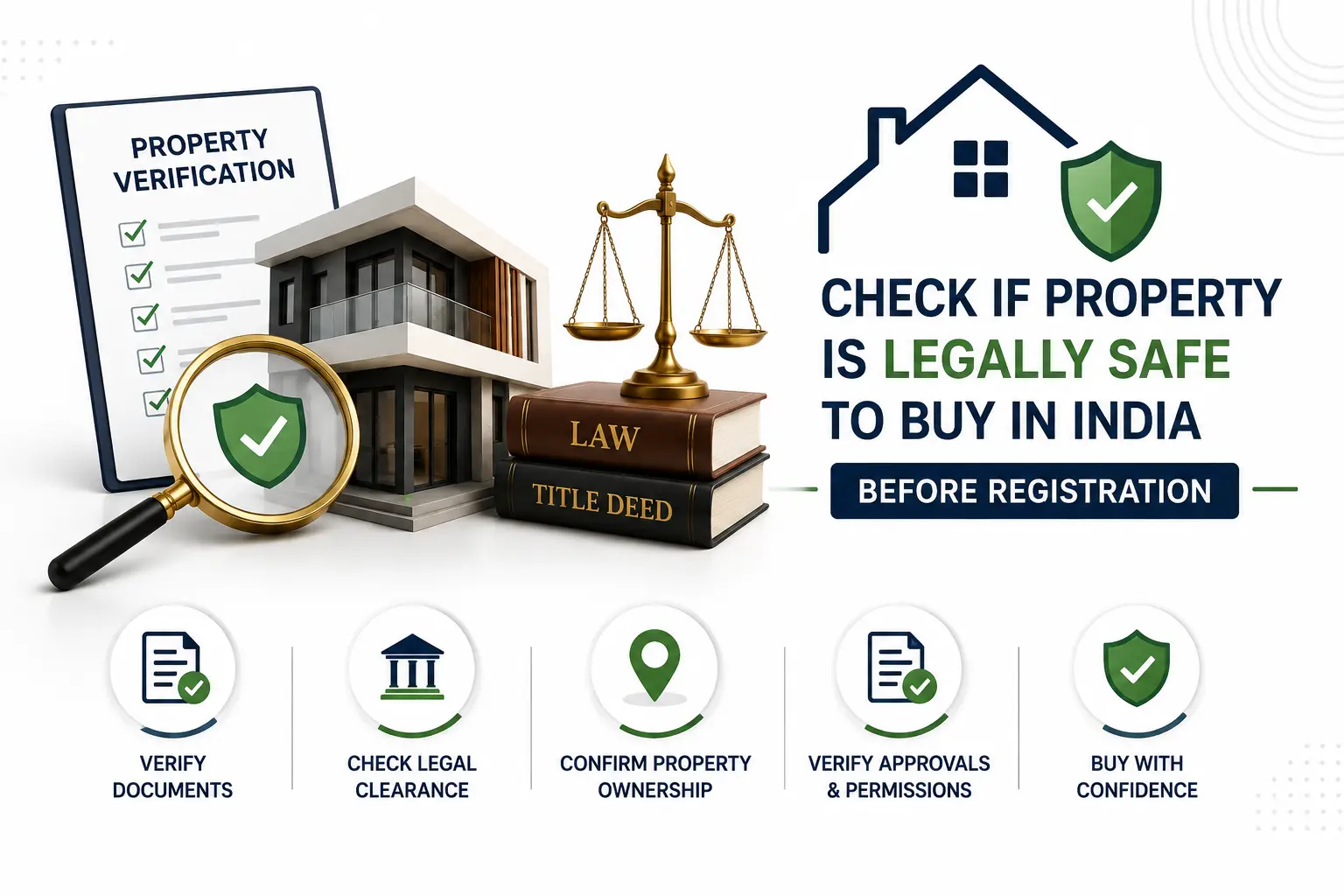
Property Legal Verification A premium legal guide for property buyers, families, NRIs, investors and business owners who want to understand whether a property is legally safe to buy before registration. Let’s imagine you have found your dream property to buy in India. You visited the flat and liked it. You met the seller and negotiated a price. You also arranged funds for booking. All is left is registration. Suddenly, you remember one important thing. What about checking if property is legally safe to buy ? Purchasing property may look easy until you discover a faulty piece of paper after you’ve already paid and registered. You may then spend more money and time fixing documents than what you saved while buying. A legally safe property is not defined just by possession or by producing a sale deed. Properties can have pending legal disputes even after registration. A legally safe property to buy has five features - Unsafe property titles are common in India due to buyers relying only on registry copy without understanding property documents. Owning property in Delhi NCR, Noida, Gurugram, Faridabad, Mumbai, Pune, Bangalore or Hyderabad means dealing with builder documents, society paperwork, mutation entries, loan closure papers, authority approvals and family ownership details. Property buyers, family members, NRIs, investors and business owners ask Advocate BK Singh if it’s safe to buy property in India. Most law advisors simply say - get it reviewed. But who can review? Advocate BK Singh helps verify property documents before you pay large token money, sign agreement to sell or even register the sale deed. Call Property Lawyer Delhi for expert guidance because property law advisory covers title verification, property disputes, possession suits, injunctions and real estate legal advice in Delhi NCR. Property frauds are getting sophisticated by the day. From fake owners to defective sale through GPA,Builder dues, Property in dispute, Violating constructions norms, Duplicate approvals and sale papers to hidden bank loans - these are usual scenarios faced while buying property in India. Buyers facing property danger usually find it in Delhi NCR and all major Indian cities due to two main reasons. They trust the broker. They don’t verify the title before paying booking amount. Purchase may be completely safe but legally risky. Check these legal risks - Due diligence is essential while buying property because it ensures your money is safe. It ensures you can avail loan from bank. It ensures you will get possession. It ensures you can resale property in future without litigation. Property buyers often call Advocate BK Singh after paying token money or completing agreement to sell. They wish they had asked “ Is it legally safe to buy property ? ” Caution: Property that is under litigations, has bank loan, ownership disputes or ownership restrictions by authorities is NOT safe to buy. BK Singh can help you review sale documents, inspect seller’s papers, understand risk factors and decide if it’s safe to buy property before taking final step. Trust is good. Self verification is better. Many factors decide if it is safe to buy property. Let’s first understand the central legal matter with property buying in India - Reasonably safe property is when current seller has clear ownership to sell. Seller has lawful possession. There are no restrictions on transfer of property. All documents are legally aligned for this transaction. There are no hidden liens or major disputes. Title - Title decides everything related to property. Weak title affects safety of possession and registration. Buyers mix up 3 terms - Posession, Registration and Ownership. Know the difference - Registration alone cannot guarantee safe title. A seller may be residing in a rental property. On paper, an old agreement to sell exists but sale deed is not registered. Maybe someone in family is claiming ownership as ancestral property. Builder has possession of flat but did not receive completion certificate. Advocate BK Singh reviews all sale documents carefully and advises you if seller has right to sell property. Will you get safe title after registration? Property paper verification is wider than simply reviewing title documents. Understand the legal aspect of property verification in India - Indian laws that impact property transactions are Transfer of Property Act, 1882 , Registration Act, 1908 , Indian Stamp Act and individual state stamp laws, local municipal laws, various Development Authority rules, Real Estate (Regulation and Development) Act, 2016 or RERA and local body revenue laws. Property seeker must be careful about flat approvals if buying under construction project from builder. Certified copies of RERA registration, sanctioned plan, approved building layout plan, occupation certificate (OC) or completion certificate (CC), builder-buyer agreement, allotment letter and possession letter must be reviewed. Buyer needs to carefully verify title documents if buying agricultural land or vacant plot. Khasra, khatauni, jamabandi, mutation,source of land,land use type, conversion certificate, partition status, acquisition history and local authority records are points to be checked. In case of resale flat, focus is on chain of sale deed, society NOC if applicable, maintenance or repair dues cleared by seller, electricity and water dues cleared by seller, loan closed by seller, proof of possession and encumbrance status. BK Singh advises all property buyers in Delhi NCR to get property due diligence report from property lawyer before making payment. If you are planning to buy property in India - read this guide. Even more if property is resale property, family property being sold by husband, wife, brother or sister,builder sold property, transaction involves sale through GPA, property sold in payment of loan, property received as inheritance or gift from family members, sold by tenants or property is under disputed ownership. Home buyers, working professionals, NRIs, senior citizens, investors, startup teams investing in office space, companies purchasing land for warehouses or buyers investing in commercial plots need to read this. If you are a first time property buyer in India, read this guide to know what document gaps you should look for. If you have already bought properties in India, read this because one unchecked encumbrance can land you in property litigation. Advocate BK Singh assists many buyers even after they’ve paid advance money because property they intended to buy has some documentation issue. Suddenly seller is taking long to provide papers, original documents are not being shared, seller wants to modify agreed terms after registration or denying promises made. Check identity of seller first. Ask for KYCdocuments like Aadhaar card, PAN card, address proof and ownership proof. If the seller is selling through his power of attorney holder, check the POA document very carefully. Buyer should be aware of risks in property sale through power of attorney. If the real owner is missing, deceased, unknown or does not want to sell the property, then transaction can be legally contested later. Advocate BK Singh always asks more questions before buyer pays seller. Ask seller to provide previous sale deed, gift deed, partition deed, relinquishment deed, will, probate copy, allotment letter or conveyance deed. Trace back how ownership changed hands from previous owner to current owner. Don’t let seller skip any middle owner in sale chain. Check who is actually in possession of the property. Is there any tenant? Is there any licensee? Does seller promise vacant possession on sale? Do not trust oral promises. Ask for it in writing. Terms of possession should be clearly spelled out in agreement to sell and sale deed. Property may be encumbered against bank loan or NBFC loan. Ask seller to provide loan closure letter from bank, no dues certificate from bank and original papers. In case bank loan is not closed yet, buyer should not hurry to make payment to seller. Care should be taken on how payment is routed to seller. Verify sanction plan, building approval papers,completion certificate or occupation certificate, property tax history, electricity board meter details and water connection document. Title verification for land involves different set of documents. Verify land use, source of land, revenue records, check if property is acquireable by government, conversion certificate(if agricultural land) and local access roads. Get seller to provide written statement that there is no pending case, injunction, pending dispute by family members, pending bank loan or creditor case against the property. Court search of title maybe required in high value transactions. Buyer should consult a lawyer and understand potential history of litigation against property before making payment. Ensure all sale price, payment schedule, possession timeline, document handover conditions, loan closure conditions are clearly mentioned. No default clauses, refund terms or dispute resolution methods. Ensure agreement to sell is legally valid. Most buyers sign arbitrary agreement to sell just because seller has prepared it. Later buyers have difficulty proving who is at fault. Retrieving money becomes difficult after registration when dispute arises. Registration should be final step after legal due diligence, deciding payment schedule and verification of all papers. After registration, keep sale deed safely with you. Preserve all proofs of payment, possession letter from seller, tax receipts and utility service transfer documents. Apply for mutation. Call Advocate BK Singh to review your set of documents before you register. Save time and efforts later. Verify property title before making token payment. If you have already paid token money, get documents verified before signing agreement to sell. Document verification may take few days if all papers are present. Ownership chain may take longer to verify if property is old, purchased from heirs, seller doesn’t have all documents or you need to verify with local authorities. Never pay all your money before due diligence. Once you pay a hefty amount, you will have less negotiation power with seller. Buyer dispute is common with builder sale properties in Delhi NCR. You see unauthorized construction, unfit for purpose building or floor on which possession was promised 5 years back. Fraud is also common in resale flats which have old loan history. In these scenarios, Advocate BK Singh generally advises to get all documents in writing before taking next step. Unsafe property titles lead to title disagreement, loss of possession, difficulty getting bank loan, unable to sell property,property can be demolished, family fights over property and end up in civil courts for 7 to 10 years. A person may buy property and find out later that wife is also legal owner. Society may ask you to pay all overdue maintenance when you were not even aware that property had unpaid dues. Builder may have not completed your floor as per promised plan. Seller may have already taken bank loan on property. Property litigation cases drag on for many years. Courts are slow and expensive. You may have valid sale deed registered but it takes a long time to prove your side and clear your title. Avoid such situations by investing few hours and money in understanding property risks before buying. Advocate BK Singh helps clients understand legal risks before they become real lawsuits. Seek legal help if you plan to buy property which is resale, received as inheritance, family jointly owns it, property is mortgaged to bank, tenant is in possession, transaction is with builder, sale by power of attorney, property is under construction or property is listed at below market prices. Seek legal help if seller is not giving all original documents, provides photocopies only, not willing to share past transaction details, pressuring to pay full amount quickly, avoiding terms in writing and saying - “it will all get done at the time of registration.” You already have property dispute with seller? Court case filed against property you intend to buy? Contact Advocate BK Singh or Property Lawyer Delhi to know what legal notice can be sent to solve property matter. Property Lawyer Delhi provide title verification services, document scrutiny services for property transactions, sale deed verification for resale flats, property dispute verification, checking for possession issues, legal notice drafting for property matters and pre-property purchase verification. BK Singh will go through documents, understand risk factors and advise you on safety of transaction. Will you get safe title after registration? Transaction advice varies from client to client as property paper history is unique to every transaction. Simple advice for buyer - Don’t enter into property transaction if legal aspects are not clear to you. For seller - try to complete property transaction without your buyer coming back to you after registration. For family - avoid being split because of property. Connect with us through our verified contact us page for property law related legal advice. Check property title history, verify seller ownership, understand type of possession, validate construction approvals, check tax dues, inspect loan status, probe into litigation history and understand any transfer restrictions on property. Call Advocate BK Singh to review these points before you buy property. Registered sale deed is good starting point but may not be enough. Inspect past title history, capacity of seller to transact, any pending court disputes, loans or charges against property. It is advisable to do basic verification of property before paying token amount. If you have to pay token amount first, ensure you get refund terms in writing and dont pay large amount to seller before checking all papers. No. Though bank does its own verification. However it does not eliminate the need for buyer to review property documents independently. Sale history, allotment letter, buyer-builder agreement, possession letter,OC/CC, society NOC(if applicable), tax receipts, utility bill receipts, loan closure and seller KYC documents should be reviewed before buying flat. Revenue records, sale history, mutation record,land use map, conversion certificate(if agricultural land), acquisition history, encumbrance-free certificate and local authority road access approval should be reviewed before buying land. Yes. But only after you carefully verify will of deceased, probate if needed, signed by all legal heirs, partition deed or relinquishment deed and jointly check by all concerned family members. Yes you can. But transaction structuring is important. Loan should be closed, bank should give NOC for no dues, all original documents should be returned by bank and payment routing should be documented. Advocate BK Singh can review property sale documents, help you identify title risk factors, review agreement to sell and advise you buyers before property registration. No available history of past ownership papers and pressuring by seller to buy property quickly is big red flag. Seek legal advise immediately. Buying property is exciting yet scary. Many things can go wrong if documents are not carefully reviewed. Buying property through correct channel is just half the work. Ensuring legally safe property transaction is equally important. Don’t skip legal verification before buying your dream property in India. Advocate BK Singh guides home buyers, families buying property, NRIs investing in India and businesses checking if property is legally safe to buy in India before making payment or registration. Explore or contact our legal advisors at Advocate BK Singh Law Office for advice on selling property in India. Information provided in this article is for general information purposes only. This article should not be treated as legal advice for your specific case.Check if Property is Legally Safe to Buy in India Before Registration
Why You Should Care About This Property Issue in India in 2026
Fast Facts -
Title Matters
Legal Aspects of Property Verification in India
Who Should Read This Guide
Simple Steps to Check if Property is Legally Safe to Buy in India
Step 1 - Understand from Whom You Are Buying Property
Step 2 - Trace Title of Property from Root
Step 3 - Validate Possession
Step 4 - Verify Loan and Encumbrance Status
Step 5 - Validate Approvals of the Property
Step 6 - Search for Pending Litigation
Step 7 - Scrutinize Agreement to Sell Before Signing On Paper
Step 8 - Register with Proper Advice and Keep Document Safe
Documents Required to Check if Property is Safe to Buy
Document List Why Sale deed history To see how property changed hands Agreement to sell Conditions before final registration Mutation entry Check municipal/revenue records Encumbrance certificate or search Title check for mortgages/charges Tax receipts Property local tax payment history Utility bills Electricity,water proves occupancy history Approved plan Checks sanctioned plan by authority Occupation certificate Required for builder bought property Society NOC Necessary in apartment transaction Loan closure letter Ensures builder cleared bank loan Seller KYC ID Validates seller’s identity Court search paper Litigation search against property Will/Probate/deeds Property inherited from someone Partition deed Family property split Timeline
Don’t Ignore These Common Mistakes
How Safe is Unsafe Property?
When to Seek Legal Help
Services by Property Lawyer Delhi
Property FAQ’s
1. How can I check if its safe to buy property?
2. Is sale deed being registered enough proof of safe title?
3. Should I pay token amount before verifying property?
4. Can bank loan approval document be taken as proof of safe property?
5. What are the documents to be checked before buying flat?
6. What are the documents to be checked before buying land?
7. Can property bought through inheritance be safely purchased?
8. Can I buy property if seller has home loan?
9. Will Advocate BK Singh help me before property registration?
10. What is the biggest property danger sign?
Closing Facts
Disclaimer
There's no reason for concern. There is no difficult-to-understand legalese.
Someone who has helped many people with the same problems gives you clear, honest advice. We want to make the legal process easy to understand and use for everyone.
Schedule Your Consultation