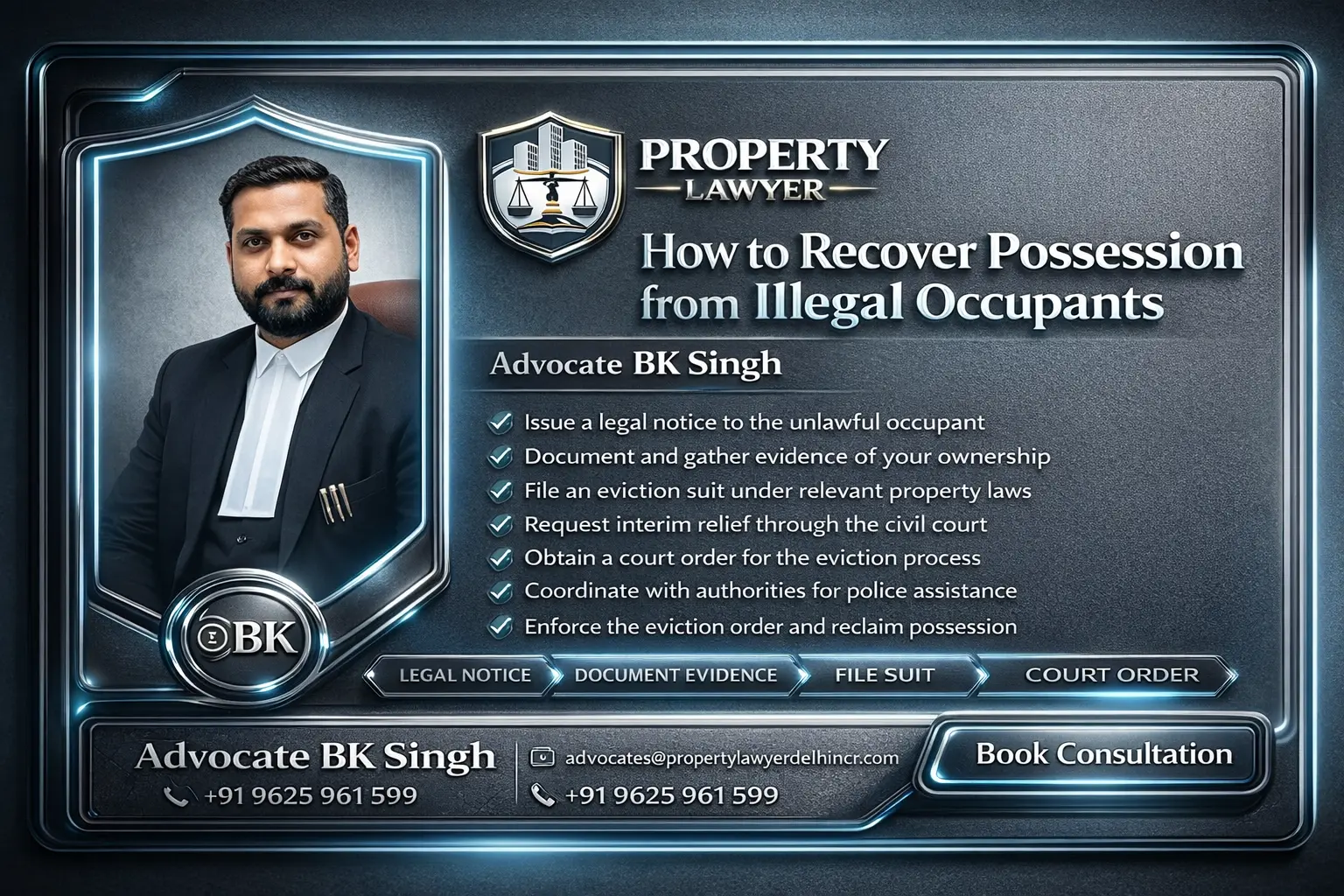
How to Recover Possession from Illegal Occupants
One of the most stressful things that can happen to a property owner is losing control of their own property. There are many ways that people can illegally occupy land in Delhi and all over India. Sometimes a caretaker won't leave. After a fight in the family, a relative may take over the house. In some cases, a tenant stays after the lease ends, or a trespasser sneaks onto an empty lot and starts claiming rights. Most owners make the mistake of getting angry and trying to get the tenant out by force. Indian law generally says that possession should be restored through due process, not self-help. This is why taking legal action quickly is important. Sections 5 and 6 of the Specific Relief Act, 1963 talk about getting back possession of immovable property. Civil courts can also give injunctions and mesne profits in some cases.
For a lot of middle-class families and small business owners, having one property occupied can be a financial disaster. A shop that is locked means lost business. A family home that is already occupied can't be sold, rented, or used for personal reasons. A plot that has been encroached on can cause problems with documents and money for years. This is when practical legal planning becomes very important. It's not just about ownership papers in a property recovery case. It is about showing proof of possession history, figuring out what kind of occupant is there, picking the right remedy, and acting quickly before things get more complicated. Property lawyer Delhi and Advocate BK Singh often handle these cases by combining title review, building evidence, planning notices, going to court, and, if necessary, using criminal remedies for trespass, threats, forgery, or breach of peace.
1. What it really means to have an illegal job
Not every illegal occupation starts with a stranger breaking a lock. In real Indian property disputes, illegal occupation often happens when a relationship that seemed legal or temporary turns into one. A licensee may stay longer than allowed. A staff quarter may be held by a former employee. During negotiations, a buyer may come in and then refuse to leave. During a succession dispute, a relative may take over. The legal strategy changes based on how the person got onto the property in the first place. That difference is important because a simple police report might not fix a civil possession problem, and a civil suit might take too long if there is active trespass, intimidation, or forged paperwork.
In many cases, owners use the term "illegal occupant" too loosely. However, courts will closely examine whether the person is a trespasser, tenant, licensee, co-owner claimant, family occupant, or someone claiming title. That is why it is important to write legal documents correctly from the start. If the wrong case is filed, time is wasted, and the person living there gets stronger on the ground. Advocate BK Singh's main goal is to figure out which legal category is right. This is because it is much easier to get back possession when the pleadings match the facts on record and the evidence is organized from the start.
2. Why you should never try to forcefully remove the occupant
People who own property often think they can break into it, throw out things, or cut off important services because they own it. In reality, that method can go wrong very badly. Courts have repeatedly said that even disputes over possession must be settled through legal means, not by taking the law into one's own hands. The Specific Relief Act's Section 6 exists so that even someone who has been wrongfully dispossessed can get their property back quickly if they act within six months.
This idea surprises a lot of property owners, but it is very important. The law doesn't like private force because it can lead to violence, false criminal cases, and long fights over who owns something. It is safer to record the wrongful occupation, send a legal notice if necessary, keep proof of title and prior possession, and move to the right forum right away. Property lawyers in Delhi usually tell owners to protect themselves legally first, especially if the person living there is violent or has ties to the government.
3. The main legal options in India
The first big fix is a civil suit for possession based on title under Section 5 of the Specific Relief Act. This is usually used when the owner has clear title and wants to get back a specific piece of real estate through the court. The owner may also ask for a permanent injunction to stop further interference and mesne profits or damages for wrongful use and occupation. There are decrees for possession and mesne profits in the Code of Civil Procedure. The legal definition of mesne profits includes profits that a person in wrongful possession actually received or could have reasonably received.
The second most important way to get help is to file a summary suit under Section 6 of the Specific Relief Act. This is helpful when someone has been kicked out of their home without their permission and not through the proper legal process, and the lawsuit is filed within six months of the eviction. This kind of case is not about final title adjudication; it's about prior possession and unlawful dispossession. In cases of sudden lock changes or forced occupation where time is of the essence, this can be a very effective solution.
Depending on the facts, the third route could involve breaking the law. The Bharatiya Nyaya Sanhita, 2023 has specific rules for crimes like criminal trespass and house-trespass. Criminal law doesn't take the place of a civil possession suit, but it can be important when there is forced entry, intimidation, damage, document forgery, or a real threat to peace. In some cases, both civil and criminal remedies work together because they deal with different parts of the wrongdoing.
4. How a lawyer usually makes a strong case for getting back possession
Documents are the first step in building a strong case, but they aren't the only ones. A lot of the time, courts and other authorities look at the whole possession story. That could include title documents, mutation papers, property tax receipts, electricity bills, water bills, photos, site plans, rent or license agreements, termination notices, WhatsApp chats, police complaints, witness statements, and proof of when the tenant moved in and why their stay was no longer allowed. If the property is for business, records of lost business can also help prove the claim for damages or mesne profits.
Then, the legal writing has to match the facts. For instance, if the tenant was only allowed to stay for a short time, the pleadings should clearly show that they were allowed to stay, that they were no longer allowed to stay, and that they refused to leave. If the case is about recent forced eviction, the urgency and timeline become very important. If the occupant is lying about owning the property, the case may need reliefs related to title, possession, injunction, and the ability to cancel or challenge suspicious documents. Advocate BK Singh usually sees these cases as evidence-based because clear facts and clear paperwork often determine how quickly and strongly someone can recover.
5. Practical examples that are common in Delhi and NCR
One common situation is when an owner lets a caretaker stay in a room or floor to help with management. The caretaker won't leave after a few years, changes the locks, and starts saying the owner left the property. In these situations, the owner may need to show that the caretaker was allowed to have the property from the start and that there was never a change of ownership or tenancy. Civil recovery action becomes more important when the person living there starts making false claims to put pressure on them.
Another common case has to do with property that belongs to the family. Let's say two brothers inherit a house, but one brother lives in the whole house and keeps the other brother's family out. These issues often start as emotional family fights but turn into serious legal battles over property and title. A third common pattern has an effect on small businesses. A store owner lets a friend use the store for a short time, but then the friend refuses to leave and keeps running the business from the store. Every month of delay means lost income for small business clients, which is why mesne profits are so important. Property lawyer delhi often finds that giving early legal notices and filing quickly stop the tenant from making up a fake paper trail.
6. What courts usually look at before giving help
When someone goes to court, the court usually looks at who had legal title, who had actual possession, how the person got in, when the occupation became illegal, and whether the person who filed the lawsuit did so quickly. Delays can make it harder to get back to normal, especially when the person living there starts making utility records or fake documents. In title-based lawsuits, documentary ownership is still very important. In Section 6 matters, the focus is on previous possession and recent unlawful dispossession. In cases of mesne profits, the court may look at how much money was made from the wrong occupation.
Another thing that courts look at is whether the plaintiff picked the right relief. If the defendant already has the property and the title is in dispute, a simple injunction suit may not be enough. In these situations, it is important to frame possession-based and title-based relief correctly. That's why it's so important to have a good strategy when filing. Advocate BK Singh thinks it's important to choose the right cause of action from the start because a case that isn't strong enough can delay relief even if the owner is really wronged.
7. How this service is good for middle-class families and small businesses
A house is often the result of years of saving, planning for retirement, or inheriting money from a family member for a middle-class family. When someone illegally lives on that property, the stress is not just legal. It has an effect on safety, respect, rental income, kids' plans, and chances to sell in the future. A lot of families don't know if they should go to the police, the civil court, or the tax office first. They are also worried about the cost, the delay, and the possibility of retaliation. A careful plan for getting back their things gives them clarity and helps them avoid mistakes in the beginning.
Disputes over possession can stop cash flow right away for small businesses. A warehouse, office, shop, or godown that is being used without permission can mess up supply chains, licensing, staff deployment, and customer trust. When it comes to these kinds of things, legal action isn't just about pride in ownership. It is about keeping your job safe. Advocate BK Singh and property lawyer Delhi want to help their clients go from panic to structured recovery by giving them clear next steps, realistic timelines, proper documentation support, and focused representation.
8. Why planning your legal strategy early makes a big difference
When owners wait too long, possession issues get harder. People who live there can make things more confusing, bring in more people, change the conditions on the site, or file complaints before the deadline. Doing legal work early helps get evidence, correctly define the issue, and keep the case from getting more complicated than it needs to be. If the dispossession happened recently, the six-month summary remedy under Section 6 may be very helpful. This means that timing can directly affect the type of relief that is available.
There is no one-size-fits-all legal solution. A possession suit is needed for some things. Some people need both an injunction and mesne profits. Some use criminal trespass complaints as a way to support their actions. Others depend on title, succession, or fake documents. The best way to handle every illegal occupant case is to treat it as fact-sensitive and full of paperwork. Advocate BK Singh is different because he does clear case assessments, communicates clearly, and takes focused action for people who want to recover legally without any unnecessary drama.
Reviews from Clients
*****
Rakesh Malhotra
I was completely worn out because a person I had let stay at my house for a short time refused to leave and started acting like they owned it. Advocate BK Singh took care of the situation very calmly and used simple language to explain each step. What I liked most was the clear plan. There was no empty promise, only good legal advice. That clarity made me feel like I was in charge again.
*****
Shweta Arora
My family was dealing with an illegal occupation problem in a house that had already caused fights between family members. I was feeling a lot of stress and didn't know where to begin. The property lawyer in Delhi helped us with papers, notices, and court action in a way that felt honest and useful. Advocate BK Singh was patient, smart, and very clear. That really helped us feel better during a tough time.
*****
Imran Qureshi
I own a small business and the illegal occupation was starting to hurt my monthly income. After wasting time with informal requests, I called Advocate BK Singh. The advice was clear, professional, and based on facts. I liked that the case was looked at carefully before anything was done. It seemed like someone was really looking out for my best interests instead of just talking in general.
*****
Neha Bansal
At first, it seemed easy to occupy our empty property, but things quickly got legally complicated. BK Singh Advocate understood how serious it was right away and told us what proof would be important. That practical advice kept us from making mistakes based on our feelings. I felt supported the whole time, and the whole process was organized and calming.
*****
Sanjay Verma
I approached Property lawyer delhi after months of stress over possession of a family property. Advocate BK Singh paid close attention, reviewed the papers, and gave a plan that finally made sense. The best part was that everything was explained in simple English, so there was no confusion. That kind of legal help is very helpful when you're already worried.
?FAQs
Q1. How can I recover possession from an illegal occupant in India?
You usually need to know how the person got into the property and what papers you have first. Depending on the facts, you may need a civil suit for possession, an injunction, a claim for mesne profits, or in some cases criminal action for trespass. Sections 5 and 6 of the Specific Relief Act are especially important in possession matters.
Q2. Can I remove an illegal occupant myself if I am the owner?
Trying to remove someone by force is risky and can lead to criminal complaints and further litigation. Indian law generally expects possession disputes to be resolved through due process. Even unlawful dispossession can trigger a summary remedy under Section 6 if the person approaches the court in time.
Q3. What is Section 6 of the Specific Relief Act?
Section 6 provides a summary remedy to a person who has been dispossessed of immovable property without consent and otherwise than in due course of law. The suit must generally be filed within six months of dispossession, and the focus is on possession, not final title.
Q4. What documents are useful in a possession recovery case?
Sale deed, agreement to sell, mutation records, tax receipts, electricity bills, photographs, site plan, notices, police complaints, chats, witness details, and any papers showing how and when the occupant entered the property can all become important. The exact document set depends on the facts of the case.
Q5. Can I claim rent or compensation from the illegal occupant?
Yes, in suitable cases you may seek mesne profits or damages for wrongful use and occupation. The CPC recognizes decrees for possession and mesne profits, and mesne profits have a defined statutory meaning.
Q6. Is police help available against illegal occupants?
Police intervention may be relevant where the facts disclose criminal trespass, threats, force, damage, or breach of peace. However, police action does not automatically replace a civil possession suit, especially where title and lawful possession need formal adjudication.
Q7. What if the illegal occupant is a relative or family member?
Family occupation disputes are common in inherited and jointly claimed properties. These cases can involve title, succession, co-ownership, partition, and exclusive possession issues. The legal remedy depends on the family structure, documents, and whether the person is asserting independent rights.
Q8. How long does a possession case take in India?
There is no single fixed timeline because the duration depends on the court, urgency, type of remedy, document quality, defence strategy, and whether interim relief is granted. Recent dispossession cases may sometimes move faster under summary remedies, while title disputes usually take longer.
Q9. What is the difference between an illegal occupant and a tenant?
A tenant usually enters under a lease or rent arrangement, while an illegal occupant may be a trespasser, overstaying licensee, unauthorized family occupant, or someone whose permission has ended. Tenant eviction may follow rent control or tenancy law routes, while illegal occupation often leads to possession suits, injunctions, or trespass-based action.
Q10. Why should I speak to a property lawyer quickly in such cases?
Delay can weaken your position, allow the occupant to create false records, and reduce access to faster remedies such as a Section 6 suit in recent dispossession cases. Early legal advice helps preserve evidence, choose the right forum, and avoid technical mistakes.
There's no reason for concern. There is no difficult-to-understand legalese.
Someone who has helped many people with the same problems gives you clear, honest advice. We want to make the legal process easy to understand and use for everyone.
Schedule Your Consultation