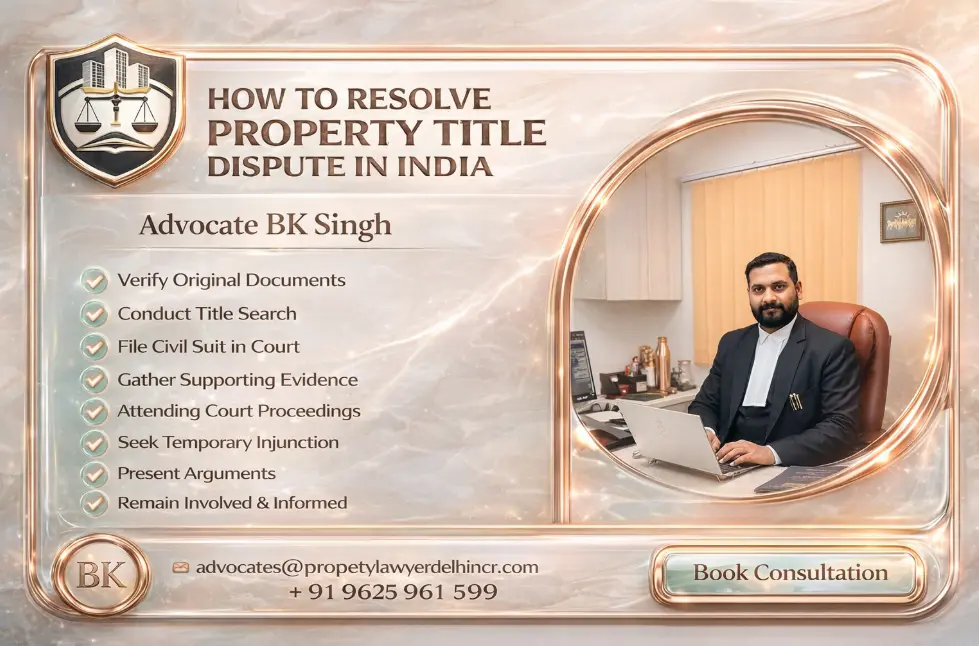
How to Settle a Property Title Dispute in India
A property title dispute happens when two or more people say they own the same property, or when there is a break, mismatch, or fraud in your "chain of title," which is the history of transfers. People in India often find out about a title problem at the worst possible time: when they are selling, getting a loan, changing their name, inheriting, or when a builder delays possession and someone else claims rights.
Don't worry if you feel stuck. You can settle most title disputes with a clean document strategy, the right legal remedy, and quick court protection, like an injunction order in a property dispute or a stay order on the sale of property.
In this guide, I'll use real-life examples from India to explain practical solutions in simple terms. I'll also show you when you should file a civil case in District Court, appeal in High Court, or go to the Supreme Court of India.
I will be talking about the service team of propertylawyerdelhi and Advocate BK Singh Advocate throughout this article. This is because many clients want one person to handle all of their document verification, notices, litigation, and settlement.
1) First, find out what "clear title" means.
In India, "title" means legal ownership, which is backed up by a set of documents and a history of possession. A clear title usually shows:
A legal sale deed or transfer document
A clean title chain is made up of the mother deed and any transfers that come after it.
No illegal transfer while the dispute is going on (risk under Section 52 lis pendens)
No fake documents, impersonation, or misuse of power of attorney property
No pending claims, like a disagreement over property between family members, builder liens, or adverse possession claims
A lot of buyers think that "registered" means "safe." Registration is important, but it doesn't always stop fraud. Courts still look at the facts, the intent, and the evidence.
2) Common Reasons for Property Title Disputes in India
You will most likely see one (or more) of these reasons:
Disputes over family and inheritance
In India, property rights without a will cause problems between legal heirs.
It gets harder to settle a dispute over ancestral property when someone sells it without permission.
Family members fight over property after talks about dividing it up fail
When a couple gets divorced and fights over shared property, it's called a joint property dispute.
Problems with documents and transactions
Case of a fake property deal using fake documents
When fraud or misrepresentation happens, you need a lawyer to cancel the sale deed.
Several deals to sell the same property
Fake GPA transfers and misuse of power of attorney property
Problems with possession and encroachment
Lawyers who handle illegal possession cases where someone lives in your flat or plot
Land encroachment is a legal way to settle disputes over boundaries and illegal building.
Adverse possession law in India explains what happens when someone who has lived in a place for a long time claims it as their own.
Disagreements about builders and RERA
What to do if the builder doesn't give you possession (delayed possession, changed layout, no OC)
Step-by-step guide to the RERA complaint process for when there are disagreements over title, approvals, or allotment terms
RERA complaint lawyer in Delhi for projects in Delhi NCR that don't follow the rules
3) Check the title like a pro before any notice or case.
You need to make a "proof file" first if you want a quick resolution. A good property title dispute lawyer will ask for these right away because your case depends on documents.
Important papers you need to get
Mother deed or root title document (if possible, the chain of ownership for the last 30 years)
Sale deed, conveyance deed, gift deed, partition deed, will/probate (if necessary)
Proof of encumbrance (any charge, mortgage, or lien)
Mutation records and tax receipts (helpful but not conclusive proof of ownership)
Proof of ownership (bills for electricity and water, society records, rent agreements)
Site plan, boundary details, khasra/khatauni if they are needed
If the property is being built, you need an allotment letter, a builder-buyer agreement, proof of payment, and the OC/CC status.
When clients come to propertylawyerdelhi for help with property verification, we usually start by making a clean "title note." That step stops wrong lawsuits and saves months.
4) First, try a legal notice and settlement (if it makes sense).
Not every title disagreement needs a full trial. A lot of arguments end when the other side sees that you have papers, witnesses, and are ready to file.
A well-written legal notice can:
Stop a sale that is about to happen, Ask for an inspection of the documents, Tell the other person to drop their claims.
Suggest mediation or a written agreement.
If you want a peaceful way to settle a property title dispute in India, ask for court-annexed mediation. A settlement is best for family and some builder disputes, especially when everyone wants to move on.
5) When You Have to Go to Court: The Right Civil Suit Choices
Your solution depends on the main issue. A civil lawyer for property disputes picks the suit based on what you want the court to do or not do.
A) Lawsuit for Declaration of Title and Permanent Injunction
If someone says you don't own something and you want the court to say you do and stop them from interfering, use this. This is a typical case in civil court about a property title dispute.
B) Suit for Possession or Recovery of Property
Use this if someone is living on your property without permission and you need to kick them out and take back your property. People look for this as a civil suit for getting back property or a lawyer for a property recovery suit.
You can file a proper possession suit with interim protection to get rid of an illegal occupant if they entered the property without permission.
C) Partition Suit (Property Owned by Family or Co-Owners)
If you own something with someone else and want your own share through the court, use this. People also look for "how to file a partition suit in India," "partition suit in District Court India," and "later partition suit appeal in High Court."
D) Specific Performance Suit (Disputes over an Agreement to Sell)
If you paid money and the seller won't sign the sale deed or tries to sell to someone else, use this. A specific performance suit lawyer remedy is what this is.
E) Canceling Documents / Sale Deed
If you are a victim of forgery, fraud, impersonation, or fake transactions, you may need to file a civil suit to have them canceled under Specific Relief principles. A lot of clients want to know if a registered sale deed can be canceled. Courts will let you cancel for good reasons, like fraud or misrepresentation, but you have to show proof.
6) Get Immediate Protection: Stay Order and Injunction (Most Important Step)
You should act right away if the other party threatens to sell, give away, or make rights for a third party.
What you can ask for
Interim injunction property case India to stop selling or transferring
Court order to stop the sale of property to keep things the same
Orders to stop illegal building or taking away property
If the court gives you an interim order, you have more time to fight your case. If that doesn't happen, the fight gets messy because other people get involved.
Also, keep in mind Section 52 of the lis pendens title dispute: even if someone sells while a case is still going on, the buyer's rights are still subject to the final decision in that case.
This rule stops "quick sale tricks," but you should still get an injunction because things get more complicated once a buyer comes in.
7) Is it possible to sell property that is in a court case?
People always want to know if property that is in court can be sold.
Under the doctrine of lis pendens (Transfer of Property Act, Section 52), a transfer that happens while a case is going on does not automatically become void. Instead, it is subject to the outcome of the case.
That means the buyer is taking a risk, and the final decree could stop or limit the buyer's claim.
Yes, someone may try to sell something, but the law does not allow them to take away your rights just because they change hands during the trial.
8) If fraud is real, take both civil and criminal action.
If you find fake signatures, fake IDs, fake sale deeds, or power of attorney property misuse, you shouldn't just go to civil court.
A strong strategy for property fraud lawsuits in India usually includes:
Civil lawsuit (cancellation and injunction)
File a police report or FIR for forgery, cheating, and other related crimes if the facts support it.
Request to keep evidence (documents, CCTV, and registrar records)
Quick injunctions and criminal complaints help a lot of clients who are dealing with NRI property fraud protection India issues because fraudsters move quickly.
Builder-buyer and delayed possession
You might need a combined strategy of consumer/RERA and civil relief if your title problem has to do with a builder project. People look for "delayed possession legal action," "builder buyer dispute lawyer," and "RERA appeal in High Court India."
Disputes between landlords and tenants and evictions of tenants
If the disagreement is about occupancy, use the right eviction method. A lot of people look for information on how to legally evict a tenant in India, a tenant eviction lawyer in Delhi, and a landlord-tenant dispute lawyer. The right solution depends on the terms of the lease, the law that applies to rent, and the reasons for the problem, such as not paying rent, misusing the property, or subletting.
Possession that is bad
If someone says they own the property because they lived there for years, the case gets a lot of evidence. A good lawyer for an adverse possession case will work to show that the possession did not meet legal requirements (open, hostile, etc.) and that you took action when you found out about the encroachment.
10) Timeline: How Long Does It Take to Resolve a Property Title Dispute in India?
People in India want to know how long property cases and title dispute cases take because they are worried about never-ending lawsuits.
In reality, the length of time depends on:
If you get temporary help early If the documents are clean or not If the other side drags the issue out If you reach an agreement through mediation
If the case goes to appeal (High Court or Supreme Court)
Advocate BK Singh often uses early interim protection, quick evidence filing, and settlement pressure as practical tools. That mix saves time for small businesses and middle-class families who can't afford to be unsure for years.
11) Appeals: From the District Court to the High Court to the Supreme Court
If the trial court makes a decision, the other side can appeal. Clients often ask for:
the process for appealing a property case in the High Court of India, second appeal property case in the High Court, Supreme Court case about a special leave petition
To win an appeal, you need to be good at writing legal documents and keeping records. If you keep your paperwork in order from the start, it will help your case in all courts, even the High Court and the Supreme Court of India.
12) Why middle-class families and small businesses need a practical legal plan
A title dispute doesn't just stop a sale. It stops loans, business growth, rental income, and even peace at home. A lot of small business owners put their property up as collateral. When title is challenged, banks stop lending money, which makes things even worse.
That's why propertylawyerdelhi has three main goals: check the title and find the quickest way to fix it, get the property back by getting an injunction or stay, push for a resolution through strong evidence and a settlement when possible.
You have to act quickly if you want a real result. Delaying gives the other side time to make up fake documents, sell things to third parties, and make things harder to get.
Rohit Mehra from Delhi
"I looked for a property dispute lawyer in Delhi because my uncle tried to sell our family's house. Advocate BK Singh quickly got a stay order and helped us with the partition the right way. I finally got some good sleep.
Neha Sharma from Noida
"We had to deal with a case of a fake power of attorney being used in a property deal." The propertylawyerdelhi team was very clear about how to handle the notice, injunction, and cancellation suit strategy. We got control back before it got worse.
Arvind Iyer (Bengaluru)
"My builder made me wait to move in and also messed up the title documents." I got help that was useful, not just ideas. The method saved me money and made the builder take me seriously.
Farzana Khan lives in Mumbai.
"After my father died without a will, family members started fighting and stopped the mutation." Advocate BK Singh explained property rights in India without a will in simple terms and helped us safely settle and write down the family arrangement.
Gurpreet Singh, from Chandigarh
"A tenant refused to leave and started making claims. I needed a solution that was like a tenant eviction lawyer and had good paperwork. The case went in the right direction because the plan was based on facts and stayed clean.
?FAQs
There's no reason for concern. There is no difficult-to-understand legalese.
Someone who has helped many people with the same problems gives you clear, honest advice. We want to make the legal process easy to understand and use for everyone.
Schedule Your Consultation