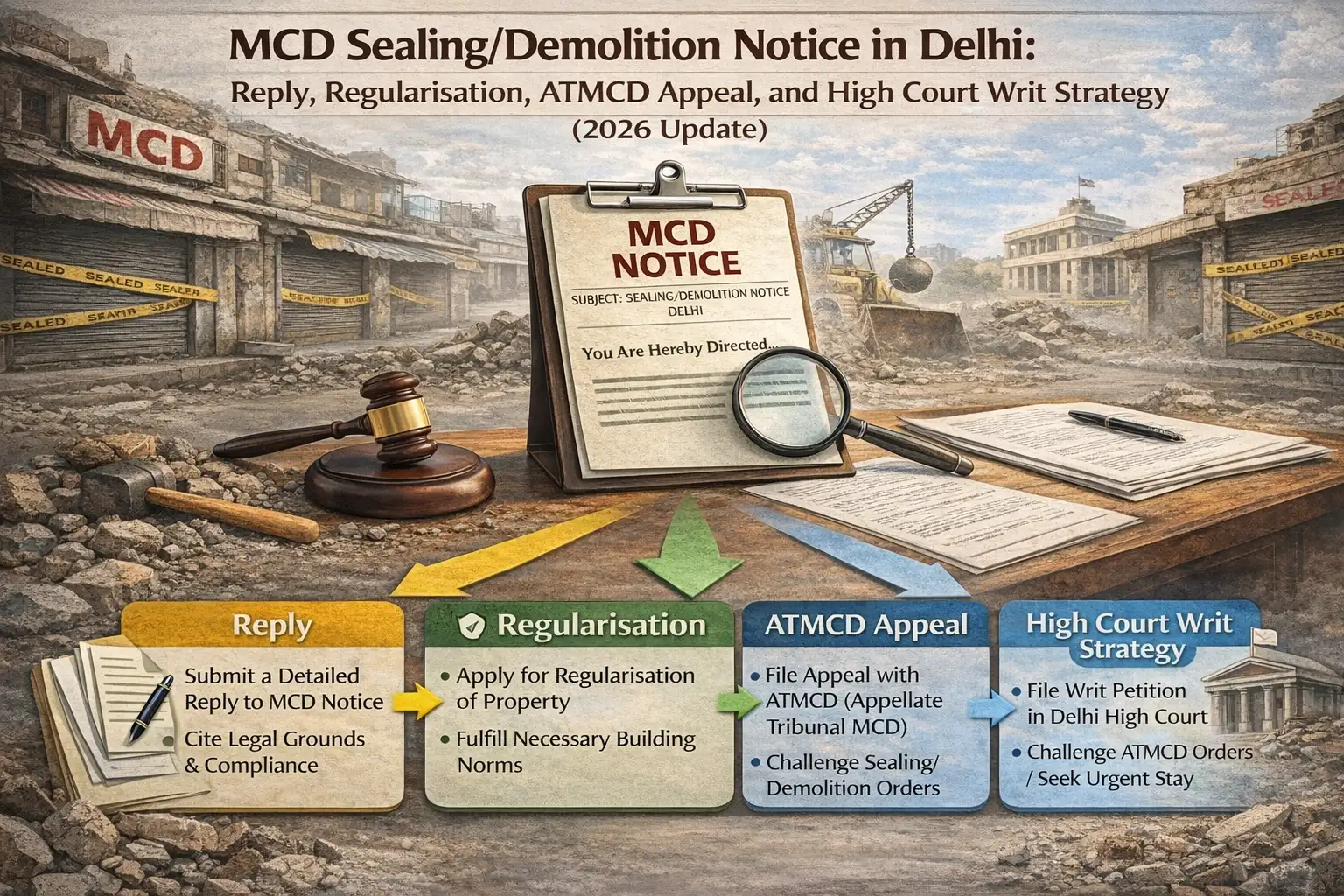
MCD Sealing/Demolition Notice in Delhi, Regularization, ATMCD Appeal, and High Court Writ Strategy (2026 Update)
It can feel like your life is on hold when you get a demolition or MCD sealing notice in Delhi. For a middle-class family, this is often the only home they have built with money they saved and borrowed. A small business owner might have a store, clinic, tuition center, godown, or office that helps them pay their bills every month. One notice and one sealing action, and everything, from EMIs to kids' fees, starts to shake.
At property lawyer Delhi, Advocate BK Singh often meets clients who are at the same point: the notice is short, the accusations are vague ("unauthorized construction"), and the date of action seems too close. The good news is that most cases get easier to handle when you don't panic and instead give facts, documents, and the right forum strategy.
This update from 2026 gives a useful roadmap:
(1) how to respond to an MCD notice; (2) when regularization is really possible; (3) how and when to file an ATMCD appeal; and (4) when a High Court writ is the right thing to do.
Sealing usually limits who can use or occupy a space (for example, by locking a business area or limiting access). It can be used when MCD says there was misuse, unauthorized construction, or ongoing violations. It's often sudden and hard for small businesses.
What "demolition" usually means
Demolition is the more direct way to enforce the law against unauthorized construction. It usually comes after internal action or orders under the municipal law framework, which is often used for things like adding an extra floor, covering a stilt, building an illegal basement, or breaking a setback rule. Legal action usually starts with the city and then goes to the appeals court.
Delhi's city government allows people to appeal some demolition and sealing orders and notices to the Appellate Tribunal.
2) Why people in real Delhi get MCD notices
These things happen a lot in Delhi: A middle-class family adds a room to their terrace for marriage or to make room for their growing kids. There is no updated sanction plan. People who live nearby complain, an inspection takes place, and a notice is sent.
Shop or clinic in a residential lane: A small store, clinic, or tutoring center is in part of the house. A competitor says there is "misuse" or "commercial activity."
Disputes between builders: The owner of the ground floor says that the owner of the upper floor made illegal changes to the projections, balconies, and stairs, which led to action by the city.
Basement/storage conversion: A property changes part of its basement into a living space, or the set-back is reduced to make more room. This is often against building codes.
Old building + "new work" claim: MCD says it is "fresh unauthorized construction," even though you may have lived there for years. Proof of age, pictures, electricity and water records, and previous status are often the most important things in a dispute.
The most important thing is that you win these cases by controlling the record, not by getting into a fight at the site.
3) The Reply: Your first legal protection (Demolition Notice Reply / MCD Sealing Notice)
A good response does three things: Prevents assumptions from becoming "official truth" in the file Makes a paper trail of following the rules and working together, Gives you a strong case for ATMCD appeal and, if necessary, writ relief, What a strong answer must have (a list of things to do)
Before drafting, property lawyer delhi's advocate BK Singh usually tells clients to put these together:
A copy of the notice or order with the date, number, zone, and property details, Proof of ownership or possession: a sale deed, GPA, will, registry chain, property tax, or mutation if one is available
Proof of site status: dated pictures and videos; old pictures from family events are more helpful than people think.
Utility proof: a history of connecting to electricity and water; bills that show how many people live on each floor
Plan for punishment or completion (if any), or architect's drawings showing the current state, Any letters or complaints from neighbors that you sent to MCD in the past (if you have them), A clear explanation of what is old construction and what is supposed to be new construction
Helpful tips for writing (what really works)
Don't deny everything in one line. Separate it into: facts that are true, claims that are false, and proof.
Request the inspection report, measurement sheet, pictures, and the reason for the accusation.
If your case is a "old structure," ask the authority to check the records and give you a fair hearing.
If the notice is unclear, politely say, "non-speaking / lacks particulars," and ask for a proper hearing.
Integrating keywords naturally: This is where terms like "demolition notice reply," "MCD sealing notice," and "illegal construction Delhi" should be used as subheadings and FAQs.
4) Regularization in Delhi: When it's real and when it's not
A lot of people type "regularisation application" into Google hoping it will stop sealing and demolition on its own. In some cases, regularization can help, but it is not a magic wand.
Delhi's building rules are based on planning standards, the Unified Building Bye Laws (UBBL), and the master plan framework that is used in many cities.
When regularization is often looked into
Small differences that can be made worse or regularized according to the rules that apply, Situations in which documentation and layout can conform to acceptable standards, Cases in which the local government itself offers a procedure to evaluate regularization or compounding in the circumstances of the case.
When regularization is usually a bad bet, Taking over public land or a right of way, Big structural problems or dangerous building issues
During the notice period, clear new construction (new work is the easiest for MCD to explain)
For example, a family in Janakpuri built a terrace room in 2023. They had pictures of the terrace parapet from 2018 and electricity bills that showed the place had been lived in before. The case was able to be defended because the reply made a clear distinction between "existing structure" and "alleged new work." The regularization angle was also seen as a secondary relief, not the only defense.
5) ATMCD Appeal: This is your main legal remedy, and it's why courts keep bringing it up.
The Appellate Tribunal (ATMCD) is the place to go if you want to challenge a municipal action that has to do with demolition or sealing. The Delhi Municipal Corporation Act lets people appeal certain orders and notices to the Appellate Tribunal.
Don't forget the time limit!
A common limit used in tribunal cases is 30 days from the date of the order or notice, but this can be extended if there is a good reason.
What you want in ATMCD, Putting aside the order to tear down or seal, Stay on demolition and interim protection, How to properly hear and reasoned order, Considering the application for regularization (if it can be maintained)
Where ATMCD is located and how to get there
The tribunal is part of the Delhi courts system and is widely seen as the right place to appeal unauthorized construction decisions.
The truth is that the Delhi High Court's orders from 2025 make it clear that petitioners have another option: they can go to ATMCD instead.
This is important for strategy: if you go to the High Court without explaining why the ATMCD remedy doesn't work, the court might send you back.
6) High Court Writ Strategy: When it helps, what works, and how to avoid getting thrown out
Most of the time, clients ask, "Sir, will I get a stay from the High Court?"
The honest answer is that it depends. The Delhi High Court usually follows the law and may tell you to file or continue before the ATMCD.
That said, writ petitions become strong when: There is a violation of natural justice (no hearing, no reasoned order).
the action is not within the law or is legally wrong, Demolition is happening right now, and ATMCD remedy is not really available.
There are times when problems with the tribunal's functioning make it impossible to even file the appeal.
The High Court has also looked at petitions about ATMCD functionality and limited protection in some cases, depending on the facts.
"Mandatory line (as requested): "Writs are powerful tools for enforcing fundamental rights." This post explains when and how to file writ petitions in High Courts, as well as what documents and reasons are needed.
What papers will help your case in the High Court?
Advocate BK Singh at Property Lawyer Delhi usually wants a "writ-ready file": Notice/order and proof of service, Your answer and proof of receipt/diary
Pictures, a site plan, and a note from the architect, Documents that prove ownership or possession, Any previous orders for the status quo or appeals that are still open, Proof of urgency (date of scheduled demolition/sealing, police notice, etc.)
Reasons that the court thinks are "real", No reasons, no measurements, and no details are allowed in a non-speaking order.
No hearing / no opportunity to be heard, Selective action / arbitrariness (backed by evidence, not just an accusation)
Most of the time, courts say they can't decide "old vs new construction" on writ record alone. This means that disputed questions of fact should usually be taken to the right forum.
Don't do any new construction or changes; new work is the easiest thing to set off.
Take pictures of everything, both inside and outside, with the date and time.
Get together papers like the registry chain, tax forms, bills, and old photos.
Day 2: Send a structured response and get ready to appeal
Send in a response with supporting documents.
At the same time as the interim stay application, prepare the ATMCD appeal.
Day 3: Pick the best strategy for the forum
File an appeal and ask for a stay if you have time.
If there is a risk of immediate demolition and the remedy is not working, you might want to think about filing a writ petition against the demolition with a narrow prayer for protection while directing you to the appellate remedy, depending on the facts.
This is exactly how middle-class clients and small businesses keep their property safe without spending a lot of money on lawsuits.
8) What this service does for middle-class families and small businesses (the real value)
It's not just a "legal problem" when a house or store is in danger; it's also a survival problem. The right legal approach helps by:
Stopping sudden sealing that stops income, Getting temporary protection while you look for the right solutions, Putting your evidence in order so that your story is legally believable, Not filing in the wrong forum, which costs time and money, Advocate BK Singh works at Property Lawyer Delhi and focuses on document-driven representation. This is because municipal cases are decided by records, measurements, and following the rules, not by loud arguments.
*****
Meenakshi Nair (Gurugram)
"My parents' house in Delhi was being torn down because of a disagreement over the construction of a terrace. The property lawyer in Delhi helped us with papers and a good legal plan. They took a practical approach, not a dramatic one.
?FAQs
Q2) How do I write a response to a demolition notice that is useful?
Respond point by point, include proof of ownership or possession, old photos, utility bills, and ask for an inspection basis or measurements. Don't just say no in one line; make a record.
Q3) Can the ATMCD stop the demolition?
You can ask for temporary protection or a stay through an urgent application, depending on the facts and whether it can be maintained. Courts often see ATMCD as the best place to settle these kinds of disputes.
Q4) How long do you have to file an ATMCD appeal?
Usually, appeals must be made within 30 days of the order or notice date, but this can be waived for good reason. Send in your application as soon as you can.
Q5) What is the difference between sealing and tearing down?
Sealing limits use and occupation, while demolition gets rid of the part that isn't allowed. Both can happen because of alleged unauthorized construction or violations, but the solutions and the need for them are different.
Q6) Can I apply for regularization to stop the demolition?
Regularization might help in some cases, but not all violations can be made regular. Use it with a clear legal plan and documents that follow planning rules.
Q7) When is it okay to file a writ petition in the High Court to stop demolition?
Usually, this happens when there is a serious violation of natural justice, a mistake in jurisdiction, immediate coercive action, or a practical inability to get to an effective alternate remedy. If not, the courts may send you to ATMCD.
Q8) If I file a writ, will the High Court always stop the demolition?
No. The High Court may only give you limited protection or tell you to go to the ATMCD, especially if there are disputed facts or another way to get what you want.
Q9) What papers are most important to show "old construction"?
Old pictures, utility bills, property tax records, old letters, and any old approved plan or architect documents. It's more important for documents to be consistent than for any one document to be.
Q10) How does a property lawyer in Delhi help with MCD sealing and demolition?
There's no reason for concern. There is no difficult-to-understand legalese.
Someone who has helped many people with the same problems gives you clear, honest advice. We want to make the legal process easy to understand and use for everyone.
Schedule Your Consultation