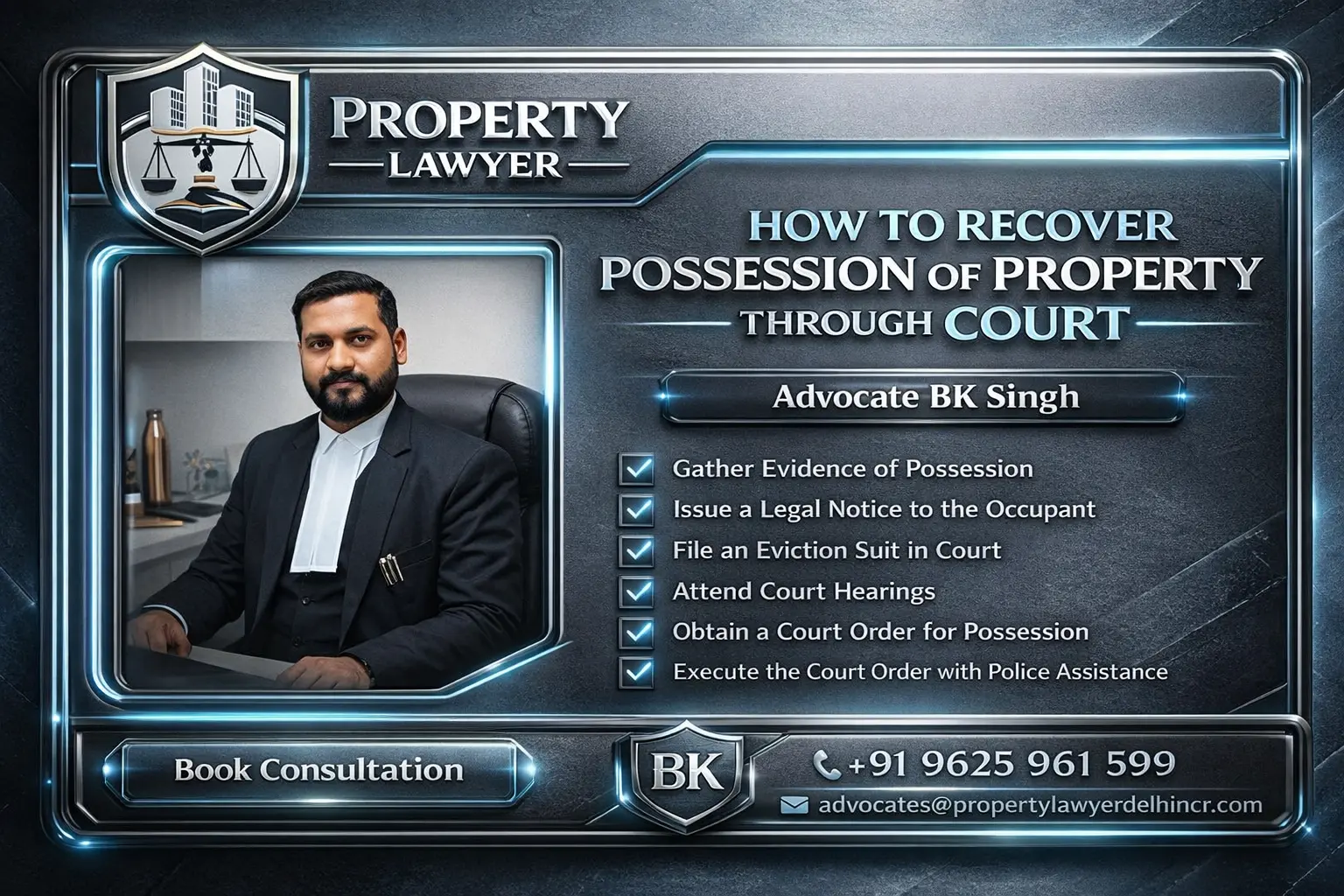
How to Recover Possession of Property Through Court
It can feel very personal to lose control of your own property. Sometimes it's a tenant who refuses to leave after being told to, sometimes it's an illegal occupant, and sometimes it's a family or business dispute where possession is withheld even though the rights are clear. In India, getting back possession of real estate is a civil remedy. The main legal ways to do this are in Sections 5 and 6 of the Specific Relief Act, 1963. Section 5 supports recovery based on the right to possession, while Section 6 gives a quick fix when someone has been dispossessed without their permission and not in the normal course of the law.
A lot of owners make the mistake of trying to get their property back by using force, private pressure, or threats that aren't official. That often leads to more lawsuits and can hurt the case. The safer way is to build the right possession case, find the right legal basis, ask for protection orders if you need them, and then properly carry out the order after it is issued. The Code of Civil Procedure also has the steps for actually giving possession after the court issues a decree. This includes getting rid of someone who is bound by the decree and won't leave.
1. When the court needs to take action
You need to go to court when someone is denying you your legal right to occupy or control the property and giving it up willingly is no longer an option. This usually happens when someone is illegally in possession of something, a tenant stays too long, a license agreement ends, a property is bought but not delivered, or a property is inherited and one side won't give up control. Property Lawyer Delhi often sees clients come in after months of informal requests, only to find that the delay has made the documents colder and the dispute harder to present clearly. Section 5 of the Specific Relief Act says that a person who has the right to own certain real estate can get it back using the method set out in the Code of Civil Procedure.
If someone has taken something from you without your permission and without following the law, going to court is the right thing to do. In these cases, Section 6 of the Specific Relief Act is very important because it focuses on wrongful dispossession instead of making the plaintiff fight the whole title battle right away. It also says that you have to file within six months of losing your property and that you can't appeal or review a decision made under that section. This is why it's so important to get legal advice from Advocate BK Singh right away if you need to get your property back quickly.
2. Which kind of possession case is right for your problem?
Not all property possession cases are the same, and the right cause of action can make a big difference in the outcome. If your claim is based on ownership or title, the usual way to go is to file a title-based suit for possession under Section 5. If the main issue is that you were wrongfully evicted, a Section 6 lawsuit may be the better option because it deals with dispossession without due process. This difference is important because one case is more about title documents and the other is more about previous possession and the fact that the property was taken without permission.
If the disagreement is with a tenant or occupant who entered the property legally, the case usually starts with properly ending the agreement and then moves on to eviction or possession proceedings. According to Section 106 of the Transfer of Property Act, a lease for purposes other than farming or manufacturing is treated as month to month and can be ended with fifteen days' notice, starting from the day the notice is received. The Limitation Act also gives landlords twelve years to get their property back from a tenant after the tenancy ends, but in practice, it's not usually a good idea to wait that long.
3. Papers that make a case for possession stronger
A strong possession case usually has clear documents, a clear timeline, and a detailed description of the property. Depending on the dispute, a sale deed, conveyance deed, allotment letter, mutation entries, property tax papers, rent agreement, license agreement, electricity bills, site plan, boundary details, photographs, possession letters, and previous legal notices can all be important. The Code of Civil Procedure says that a decree for the recovery of immovable property must include a description that is clear enough to identify the property. If possible, the boundaries or survey numbers should also be included. This is why it is important to be careful with paperwork from the very first draft.
Proof of how the possession problem started is just as important. A middle-class homeowner may need to show when a family member or caretaker stayed too long. A store owner may need to keep track of rent payments and notices. A small business may need to show that it was wrongfully kept in its warehouse or office after the end of a business deal. If the pleadings are written correctly, the court can issue a decree for possession, accrued rent, or mesne profits, and even order an inquiry into continuing mesne profits after the suit is filed.
4. How the court process usually goes
Once the right suit is found, the case usually goes through pleadings, a reply, framing the issues, evidence, and final arguments. In real life, the court wants to know four things. Who has the stronger legal claim, what exactly is the property, how did possession change hands, and what should happen next? Good drafting at the beginning makes things less confusing later on. Property Lawyer Delhi can often make a case stronger just by structuring the timeline and reliefs correctly before filing. The CPC says that judgments must list the issues that need to be decided and the reasons for the decision on each issue. The decree must also clearly state the relief that was granted.
The speed of the case depends on the type of disagreement, the quality of the documents, any interim applications, and how strongly the defendant fights for possession. A lot of clients think that just filing a case will get them back their property, but the truth is that having consistent evidence and following the right steps on time are just as important. Advocate BK Singh can make a real difference here by spotting weak points early, stopping unnecessary delays that cause confusion, and keeping the case focused on getting possession back instead of letting it get sidetracked by issues that don't need to be there.
5. How temporary protection can stop more damage
In a lot of property disputes, it's risky to wait for the final judgment because the other side might try to sell, damage, change, or further encumber the property. The CPC is aware of this problem. Order lets you get a temporary injunction if the property in question is at risk of being wasted, damaged, taken away, wrongfully sold, or if the defendant threatens to take the property away from the plaintiff or otherwise hurt them in relation to the property in question. This is often very important when an illegal tenant is trying to make things harder for other people during the case.
The Specific Relief Act also allows for preventive relief through temporary and permanent injunctions. In some cases, it even allows for damages in addition to or instead of an injunction. If the issue involves not only possession but also construction, obstruction, misuse, repeated interference, or an attempt to establish new rights on paper, a unified strategy may be necessary. For a lot of families and small businesses, this temporary stage is what keeps a manageable possession case from turning into a much bigger property crisis.
6. What the court can finally give
A possession suit is not just about saying you are right. A well-written final decree can really help. The court can order delivery of possession, give a clear description of the property, and, if requested, grant accrued rent, mesne profits, or direct further investigation into the loss suffered because the wrong occupant continued to use the property. This is important for shops, offices, godowns, and homes where the owner has been kept out and is still losing money.
The court may also issue permanent or mandatory injunctions to stop ongoing interference or force actions needed to restore rights if the facts support it. In practical terms, that could mean stopping more obstruction, stopping new encroachment, or making the person who broke the plaintiff's property rights remove the act. BK Singh Advocate usually looks at these cases not only to see how to win the decree, but also to see how to make the final relief useful on the ground after the judgment.
7. Why the execution is just as important as the decree
A lot of people think that the case is over when the judgment is made, but in possession cases, execution is often the stage that really gives control back. According to Order XXI Rule 35 of the CPC, if a decree says that property must be delivered, the person who is entitled to it must get it, and if necessary, anyone who is bound by the decree and refuses to leave can be removed. Rule 36 talks about delivery when the property is already occupied by a tenant or someone else who has the right to live there.
Execution also has ways to fix things when someone refuses to give up possession after a decree. If the person who has the decree is having trouble getting possession, they can go to the executing court under Order XXI Rule 97. The CPC also says that these kinds of objections can be decided by a judge. In some cases, the judge may even tell the applicant to take possession and send the person who is being obstructive to civil prison without a good reason. This is one reason why it is so important for Advocate BK Singh to have experience in court after a decree is won.
8. Why changing your legal strategy early changes the outcome
In property disputes, the person who is wrongfully occupying the property benefits more from the delay than the rightful owner. Documents get lost, neighbors forget the timeline, local facts get mixed up, and the other side may make up a defense based on possession, tenancy, family arrangement, or an oral settlement. Section 6 says that dispossession suits must be filed within six months. The Limitation Act, on the other hand, says that possession suits must be filed within twelve years based on previous possession, title, or landlord recovery after the tenancy ends. The law provides remedies, but it requires prompt action.
That is why the best way to handle things is not to use harsh language but to follow the law. Before a lawsuit is filed, a good possession lawyer looks into the nature of entry, the status of documents, the right relief, the need for notice, the urgency of an injunction, and the path of execution. For a middle-class family, that might mean keeping the home they worked hard to buy for many years. For a small business, it could mean getting back a store, office, or commercial space before the loss becomes too much to bear. People often choose Property Lawyer Delhi and Advocate BK Singh for these kinds of cases because they need more than just legal jargon; they need clarity, calm handling, and a practical way to get their property back.
Client Reviews
*****
Amit Sharma
When someone I trusted stopped moving out of my family's property and all my informal requests failed, I went to Property Lawyer Delhi. Advocate BK Singh explained the possession case in simple terms, made sure the papers were in order, and made me feel like there was finally a legal way to move forward. The calm advice and clear plan at every step helped me the most.
*****
Neha Verma
It was emotionally draining to deal with our residential property case because the other side kept putting it off and changing their mind. I never felt lost during the court process because BK Singh Advocate was patient and clear. The group stayed practical, polite, and focused on getting legal possession instead of making things worse.
*****
Rizwan Khan
I was about to give up hope of getting my business back because the tenant kept lying to me. The property lawyer in Delhi looked over my papers, found the right legal path, and pushed the case in a very professional way. From the first meeting, I felt supported, and I liked how each step was explained before anything was done.
*****
Pooja Malhotra
What I liked best about Advocate BK Singh was that he didn't make false promises. Before giving me advice, he looked closely at the property papers, the history of ownership, and the notice issue. Being honest helped build trust, and the way they handled my property dispute was well-organized and calming from start to finish.
*****
Sandeep Rao
Since my case involved family property and emotions were running high, I needed a lawyer who could keep things calm. BK Singh, the lawyer, stayed calm, did a lot of research, and kept the case focused on the real issue of possession. The whole thing felt serious, professional, and friendly to clients, which made a very stressful situation easier to deal with.
?FAQs
Q1. How can I get back property through the courts in India?
You can usually get your things back by filing a civil suit based on your right to possession under Section 5 of the Specific Relief Act. If you were dispossessed without consent and not in accordance with the law, you can use Section 6. The exact path will depend on whether the issue is about title, tenancy, license, or wrongful dispossession.
Q2. What distinguishes Section 5 from Section 6 possession lawsuits?
People usually use Section 5 when they are relying on their title or right to possession. A person who has been wrongfully dispossessed can use Section 6 to get their property back more quickly. They must file it within six months of the date of dispossession.
Q3. Can I file a case for property possession without using force?
Yes. That is actually the safer and more legal way. Indian law allows for civil remedies to get back possession, and the court system is meant to stop private force from taking the place of due process.
Q4. How much time do you usually need to give a monthly tenant before you file?
If there is no contract or local law that says otherwise, Section 106 of the Transfer of Property Act says that a lease for purposes other than farming or manufacturing is month to month and can be ended with fifteen days' notice from the date of receipt.
Q5. In a possession suit, can I ask for damages or charges for use and occupation?
Yes. The CPC lets the court in a suit for recovery of possession issue a decree for possession and for rent or mesne profits that have already been earned. It can also tell the parties to look into mesne profits further.
Q6. Can the court stop the other side from selling or hurting the property while the case is going on?
Yes. Order of the CPC lets you get a temporary injunction if the property is at risk of being wasted, damaged, or taken away, or if the defendant threatens to take it away or hurt it in relation to the property in question.
Q7. What papers do you need to win a lawsuit for possession of property?
Title papers, rent or license papers, legal notices, site plans, tax records, bills, possession letters, photographs, and any other document that shows who owns the property and how it changed hands are all useful. The CPC also says that the decree for real estate must clearly identify the property, including its boundaries or survey numbers if they are available.
Q8. What happens after I win the case for possession?
After the decree, you usually file execution so that the court can actually give you possession. Order XXI Rule 35 says that someone who refuses to leave can be removed from the property, and other rules cover tenants who are living there and people who resist during execution.
Q9. Is there any way to appeal a Section 6 wrongful dispossession case?
Section 6 says that there can be no appeal or review of an order or decree made in a case under that section. That's one reason why these kinds of cases should be filed and argued very carefully from the start.
Q10. How much time do I have to file a case for possession?
It depends on what kind of claim it is. You have six months from the time you lose your property to file a Section 6 suit. According to the Limitation Act, lawsuits for possession based on previous possession, title, or landlord recovery after the end of a tenancy generally have twelve-year limitation periods according to the relevant articles.
There's no reason for concern. There is no difficult-to-understand legalese.
Someone who has helped many people with the same problems gives you clear, honest advice. We want to make the legal process easy to understand and use for everyone.
Schedule Your Consultation