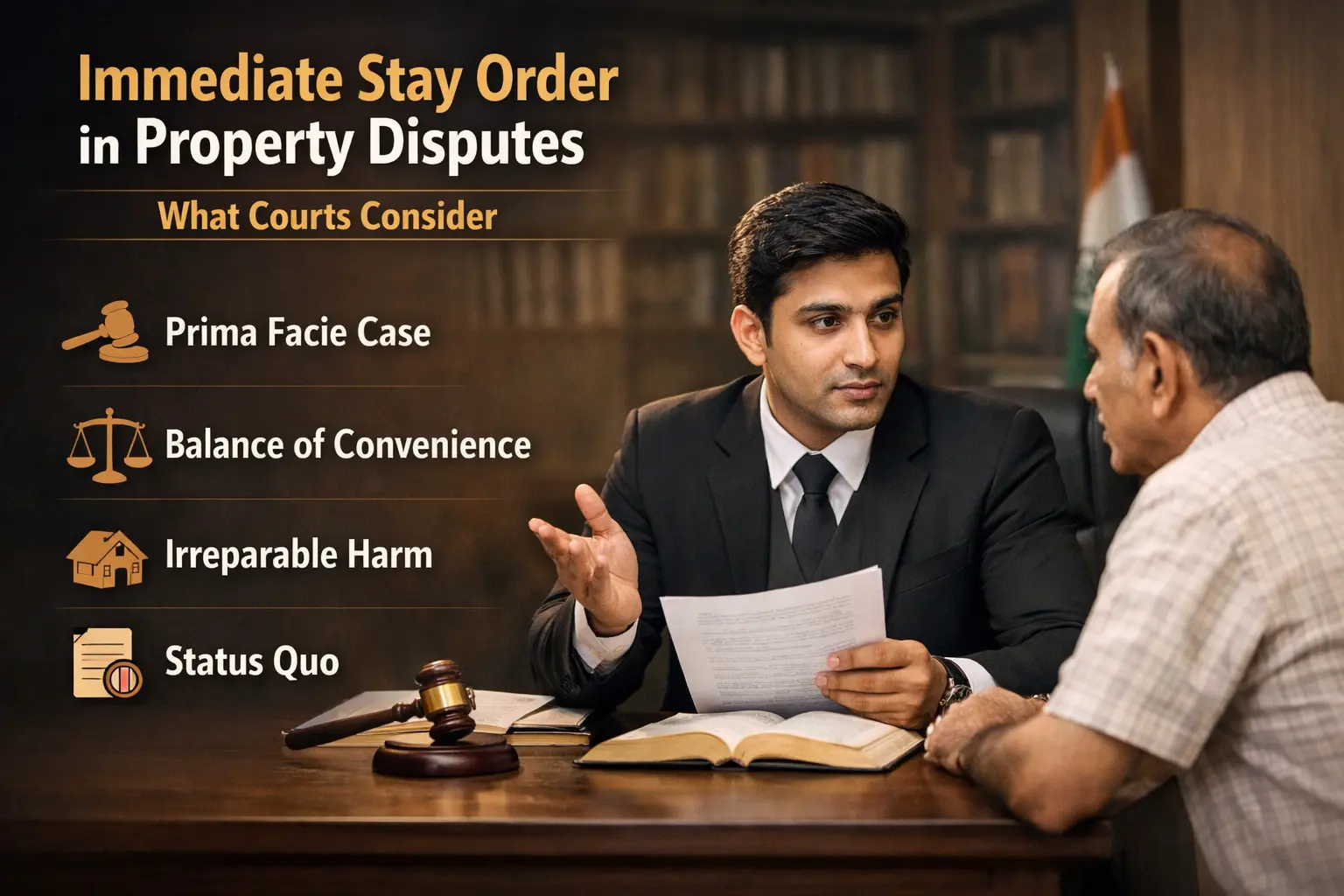
Immediate Stay Order in Property Disputes: What Courts Consider - BK Singh, Advocate
When the other side tries to change things overnight, a property dispute gets dangerous. You hear that demolition is going to happen, locks are being changed, a builder is bringing workers, or a co-owner is trying to sell the property quickly. For middle-class families, property is more than just an asset; it's also security, retirement, and respect. For small business owners, the same property could be the office, warehouse, or collateral. If they make one illegal move, it could hurt their income and reputation. That is why an immediate stay order is often the best first step in settling property disputes.
Property Lawyer Delhi deals with urgent stay and injunction cases in a way that is ready for court and based on proof. Advocate BK Singh sees "urgent stay" as a legal emergency file where timing, paperwork, and clear narration are all important. Advocate BK Singh focuses on what courts really look at: whether you have a strong case, whether you will lose something that can't be fixed, and whether the balance of convenience is in your favor. Advocate BK Singh also makes sure that your petition doesn't look like a way to buy time, but like a real request to stop damage that can't be undone. Advocate BK Singh works with Property Lawyer Delhi to make sure that clients get their papers written quickly, that the annexes are correct, and that the prayer is realistic and can be granted by the courts.
1. What an immediate stay order means in property disputes
A temporary court order called an immediate stay order stops the other side from doing certain things until the court has a chance to fully hear the case. In property cases, it usually means stopping the sale, transfer, third-party creation, construction, demolition, dispossession, or interference with possession. The goal is simple: the property situation should not change in a way that makes the final decision pointless.
Advocate BK Singh says that courts only give this kind of help when the threat is real and urgent. Property Lawyer Delhi makes the application in a way that makes it clear what will happen if the court doesn't step in today. Advocate BK Singh keeps the language clear, useful, and backed up by documents so that the sense of urgency is real and not overblown.
2. The three main tests that courts use to decide whether to grant a stay
Before giving an interim stay or injunction, most courts look at three things. First, is there a prima facie case? This means that your claim has a real legal basis. Second, whether you will suffer irreparable harm, which means harm that money can't fully fix, like losing something, having it torn down, or selling it to someone else. Third, balance of convenience means that the court looks at which side will be hurt more if the stay is granted or denied.
Instead of using emotional arguments, Advocate BK Singh builds the case around these tests. Property Lawyer Delhi writes facts in an organized way and links each claim to evidence. Advocate BK Singh also thinks about what the other side will say in their defense and comes up with short answers so the judge can understand quickly.
3. Times when courts give urgent stays more quickly
When there is a real chance of change that can't be undone, courts move faster. Illegal dispossession attempts, threats to demolish, builders rushing construction, a co-owner trying to sell to someone outside the company, forged documents being used for mutation, or a tenant being thrown out illegally are all common examples. Another type is when the person who has the family home is weak, like an elderly person, a woman, or a child.
Advocate BK Singh uses dates, notices, and behavior to show how important something is, not dramatic language. Property Lawyer Delhi often backs up claims of urgency with police reports, legal notices, pictures, and proof from the site. Advocate BK Singh also makes sure that the prayer asks for reasonable limits that fit the situation, because prayers that are too broad lose their credibility.
4. What proof makes a request for an urgent stay strong
Documents and credibility are very important to courts. Strong evidence usually includes title documents, chain papers, proof of possession, property tax receipts, electricity or water bills, a rent agreement if there is one, site photos, video evidence with clear location, police complaint copies, builder notices, and any written threats or communications. If there is forgery, documents like suspicious GPA, sale deed copies, or records that don't match up become very important.
Advocate BK Singh thinks of evidence as a story file that a judge can read in a few minutes. Property Lawyer Delhi makes sure that all of the annexures are in the right order and that each one is mentioned in the application. Advocate BK Singh also tells his clients to stay away from fake or fake papers because one questionable document can ruin the whole stay request.
5. How courts see possession and why it matters so much
The court's first concern in a lot of property disputes is who owns the property right now and if that ownership is legal. If you have settled possession and the other side tries to throw you out without following the rules, the courts are more likely to protect you. If there is a dispute over possession, courts look at the best immediate evidence available and sometimes give limited protection to keep the peace and prevent violence.
Advocate BK Singh carefully builds proof of possession, especially in cases of family partition, builder disputes, and landlord-tenant conflicts. Property Lawyer Delhi uses real-life documents like utility bills, letters from the society, and pictures to prove settled possession. Advocate BK Singh also makes sure that the pleadings don't contradict each other, because that's the main reason why urgent relief is denied.
6. Common mistakes that get your stay denied
Many urgent stay requests are denied because they are late, have vague claims, weak attachments, or wrong prayers. If you wait months and then suddenly say "urgent demolition tomorrow," the courts will be suspicious. Not telling the whole truth, like about past cases, past compromises, or past notices, is another mistake. In injunction cases, courts expect clean hands, and suppression hurts credibility right away.
Advocate BK Singh makes sure that the filing is honest and follows the rules. Property Lawyer Delhi makes the timeline clear for the court by putting it together. Advocate BK Singh also tries to show that urgency is a current trigger, based on recent actions, and not an old dispute that has been rebranded as an emergency.
7. How to write the stay application so that it fits with what the court thinks
A good stay application is short, clear, and backed up by evidence. It should name the property, explain the dispute in order, show the current threat, and then link the threat to the three tests that courts use. The prayer should be specific, such as "stop the sale," "stop the construction," "stop the dispossession," or "keep things as they are." The language needs to be calm because courts trust calm files more.
Advocate BK Singh keeps his drafts focused on the relief that the court can give right away. Property Lawyer Delhi makes sure that indexing, verification, and annexures are all correct so that the court doesn't have to deal with technical objections. Advocate BK Singh also adds a practical undertaking when necessary, because undertakings make the court more comfortable with urgent interim relief.
8. How Property Lawyer Delhi and Advocate BK Singh help from start to finish
Getting urgent property relief done quickly and correctly is important. Property Lawyer Delhi helps you quickly get the right papers, puts together the evidence pack, and makes sure the filing is ready for court without any gaps. Advocate BK Singh makes plans for the stay based on the type of dispute, such as a partition, builder-buyer, landlord-tenant, title challenge, or illegal transfer.
Advocate BK Singh also tells clients what to do after they get a stay, because many people lose their protection because they don't follow the rules or don't follow up well. Property Lawyer Delhi keeps track of upcoming dates, writes responses, and helps clients with settlement and final relief planning. Advocate BK Singh keeps things practical so that families and small business owners can get protection quickly and without taking any unnecessary risks.
Reviews from Clients
*****
Amit Sharma
lawyer, BK Singh filed my urgent stay when a co-owner tried to sell the flat. The proof was done correctly by Property Lawyer Delhi, and the court quickly protected the property.
*****
Neha Verma
My in-laws were pressuring me to leave my home illegally after we split up. Advocate BK Singh handled the stay application with care, and Property Lawyer Delhi made me feel safe again.
*****
Rakesh Gupta
I own a small store, and the landlord tried to lock it up without telling me. Advocate BK Singh acted quickly, and Property Lawyer Delhi quickly got me protection so I could keep doing business.
*****
Farah Khan
A builder made sudden changes to the construction and wouldn't show approvals. Advocate BK Singh put the case together with papers, and Property Lawyer Delhi helped stop the activity until the hearing.
*****
Sandeep Iyer
There were fake papers and attempts to change things on my father's land. Advocate BK Singh helped with the right stay strategy, and Property Lawyer Delhi made the filing clear and strong.
?FAQs
Q1. What is an immediate stay order in a fight over property?
It is a temporary court order that stops the sale, transfer, construction, demolition, or dispossession until the court hears more about the case.
Q2: When do courts quickly grant stays?
When there is an immediate threat of irreversible harm, such as dispossession, demolition, illegal sale, or unauthorized creation, substantiated by recent actions and evidence.
Q3. What are the three tests for an injunction or stay?
Before giving interim protection, courts usually look at the prima facie case, the irreparable injury, and the balance of convenience.
Q4. Can I get a stay if I don't have the original papers?
Yes, sometimes, if you have strong secondary proof like certified copies, bills, proof of ownership, and consistent records. However, original documents make the case stronger.
Q5: Is it possible to stay in a partition dispute between family members?
Yes, courts often issue status quo or restraining orders to stop changes in ownership, construction, or sale while the partition dispute is being resolved.
Q6: What if the other side says they will sell the property right away?
You need to move quickly with the papers, the timeline, and the proof of the threat. If there are facts and recent behavior that support the need for protection, courts are more likely to grant it.
Q7. Does waiting lower the chances of an urgent stay?
Yes, a long wait with no explanation makes it seem like there isn't any urgency. You need to clearly show the new trigger with dates if the threat is new.
Q8. What papers are most helpful for an urgent stay?
Title papers, proof of ownership, bills, tax receipts, photos, notices, police complaints, and any written communications that show a threat or urgency.
Q9: Can small business owners get a stay to protect their business property?
Yes, especially when illegal lockouts, evictions, or other forms of interference put people's jobs at risk. When there is proof, courts take into account how it will affect people's livelihoods.
Q10: Why should you hire Property Lawyer Delhi and Advocate BK Singh?
Property Lawyer Delhi makes quick and accurate filings, and Advocate BK Singh makes a stay strategy based on what courts really think.
There's no reason for concern. There is no difficult-to-understand legalese.
Someone who has helped many people with the same problems gives you clear, honest advice. We want to make the legal process easy to understand and use for everyone.
Schedule Your Consultation