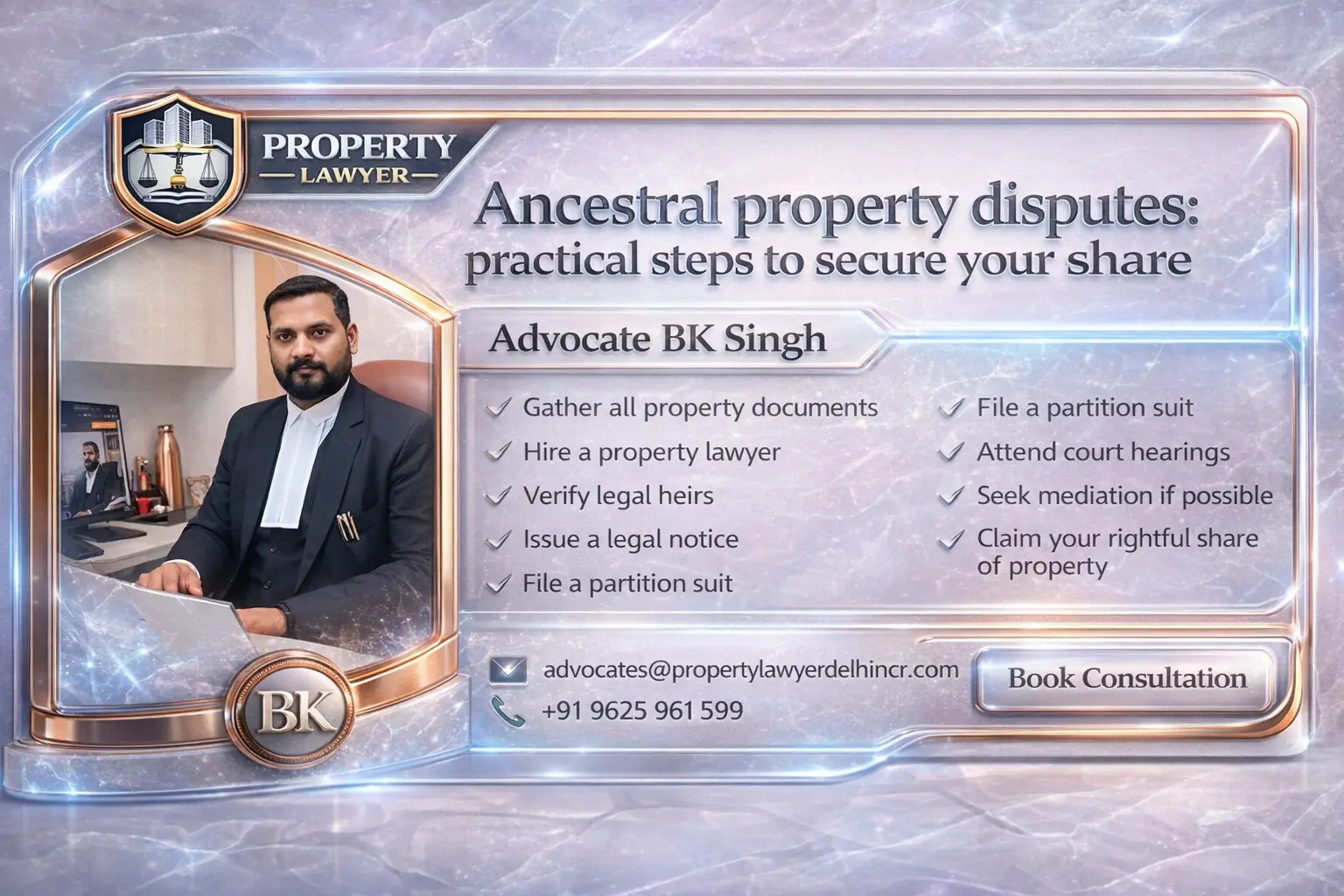
Ancestral property disputes: practical steps to secure your share
In India, disputes over ancestral property often start within families when one person takes charge of the rent money, refuses to share documents, or quietly sells part of the property through a builder deal or a power of attorney. The stress isn't just legal; it's also emotional because the people involved are often siblings, uncles, and cousins who used to live together. Property Lawyer Delhi helps you protect your fair share by giving you simple, practical steps that are strong enough to stand up in court if you need them to.
Most middle-class families waste time because they trust what people say and don't get important documents like mutation entries, khatauni, old title deeds, or family tree proofs. Advocate BK Singh focuses on taking action right away so that your share isn't watered down by secret transfers, fake papers, or illegal possession tactics. With BK Singh Advocate's calm strategy and careful documentation, you can move forward without having to fight. Property Lawyer Delhi works to turn confusion into a clear plan that protects rights and relationships as much as possible.
1. What is ancestral property, and why does it cause confusion?
Ancestral property is usually thought of as property that is passed down through the family line and gives heirs a birthright share in certain family arrangements. Self-acquired property of a parent is treated differently unless it is combined with family property. Families often mix up their records, which is where the confusion starts. Some of the land is inherited, some is bought later, and some is rebuilt into floors or shops. Advocate BK Singh helps you figure out what is ancestral, what you got through a will, and what you got on your own. This is important because it affects your legal rights and your share.
People often think that possession means ownership, but in ancestral disputes, possession is only one factor and documents are very important. If the property is joint and undivided, a brother who has lived in the house for years may still be responsible to other heirs. BK Singh Advocate says that the best way to handle property is to first check the documents to see what kind of property it is, and then choose the safest course of action: partition, injunction, or settlement. Property Lawyer Delhi makes sure that your approach is based on facts so that the argument doesn't go on forever.
2. The first signs that your share is in danger
The first sign of trouble is when a family member won't show you title papers, won't talk about partition, or makes you sign blank papers for mutation or bank work. A second sign is sudden renovations, new tenants, or collecting rent without sharing accounts, since rent is often the thing that makes someone want to take control for good. Advocate BK Singh says that as soon as you see these signs, you should start gathering documents and writing down your objections.
When you hear about a sale talk with builders, or someone tries to make a power of attorney or gift deed in their favor, that's another big red flag. In a lot of fights, a quick transfer happens before the other heirs even know what was signed. BK Singh Advocate makes sure you take action before the damage gets worse, because it's easier to stop it than to fix it later. Property Lawyer Delhi helps you take steps to protect yourself that are reasonable for middle-class families who can't afford to go through long legal battles.
3. Things you need to have before you talk to anyone
Start with the papers that show the family's connection and the history of the property. These could be death certificates of ancestors, family tree information, old title deeds, sale deeds, partition deeds (if any), and previous court orders if the family has ever been in court before. Then, get records from the revenue or municipal office, such as mutation entries, jamabandi or khatauni, receipts for property taxes, records of electricity connections, and rental agreements if the property is rented out. Advocate BK Singh makes a clear chain of documents so that your claim is based on facts, not feelings.
If the property is in a city, it is important to have floor plans and documents that show how the builder and the owner worked together. These include copies of the sanctioned plan, the collaboration agreement, the GPA, and society documents if they apply. Khasra numbers, girdawari, and encumbrance details are very important if the property is agricultural. BK Singh Advocate also looks to see if there is a loan or mortgage on the property, since that can change what you can do. Property Lawyer Delhi helps you get the most important papers together so you don't have to spend months looking for papers that don't matter.
4. Real steps to get your share without going to court right away
The best first step is to send a clear written message saying that you want your share and that you don't agree to any sale or third-party creation without a legal partition. This one step often stops quiet transfers because the other side knows there is a written objection. Advocate BK Singh often suggests starting with a structured legal notice that calmly states the facts and makes the demand for partition or settlement clear.
You should also stop signing things informally and not give copies of your ID to family members who aren't clear about why they need them. A lot of families lose their share because they signed something during a "family meeting" that later became a registered deed. BK Singh Advocate tells you how to act safely, what to sign and what to refuse, and how to keep your communication polite but firm. Property Lawyer Delhi's main goal is to protect your rights early on so that later steps are easier.
5. When to file a partition suit and what kind of help to ask for
If talks break down and the other side still refuses to give you your share or threatens to sell, a partition suit is a good way to legally define shares and divide the property by metes and bounds or through sale distribution if division is not possible. You may also need an injunction to stop the sale, stop changes to the construction, and stop the creation of third-party rights while the case is still going on. Advocate BK Singh carefully plans the reliefs so that your case is strong at the first hearing.
In a lot of disputes, people only ask for a partition and forget to ask for temporary protection. By the time the case moves forward, a sale deed or builder agreement has already been signed. BK Singh Advocate makes sure that urgent protection requests are made with the right paperwork and a clear story of why it is needed. Property Lawyer Delhi also tells middle-class families how long things will take and how much they will cost so they don't feel stuck in a process they don't understand. Advocate BK Singh works to make pleadings clearer so that there are fewer delays and misunderstandings.
6. How to deal with illegal possession rent disputes and property income
When one family member is in charge, the fight is usually about rent, shop income, or farm income. If you can, keep proof of income sources, tenant information, rent receipts, and any bank entries. This is because income is important for accounting and fair division during partition. Advocate BK Singh tells clients to ask for the right accounts and to keep track of the income that one side is keeping without sharing.
If you are denied entry or threatened, the situation goes from a quiet disagreement to an urgent need for protection. BK Singh Advocate can help you find the best legal way to protect your access, stop harassment, and keep your property in good shape. Property Lawyer Delhi handles these cases with a calm strategy so that the argument doesn't turn into a criminal-like situation unless it has to. Advocate BK Singh keeps the focus on getting a share through legal means instead of risky confrontation.
7. special situations, sisters' rights, and problems after a parent dies
Many families still believe that sisters can't claim, which puts emotional stress on them and makes settlement offers unfair. In reality, the legal rights of daughters in family property have gotten stronger over time. Sisters often need clear instructions on how to assert their share without being bullied by their family. Advocate BK Singh helps women clients by talking to them in a respectful way and keeping good records so that their claims are taken seriously.
Disputes also happen after a parent dies when one heir quickly takes control of the papers and tries to change the name on them. The death certificate stage and the legal heir documentation stage are very important because mistakes made early on can lead to fights later on. BK Singh Advocate makes sure that the right heirs are shown and that objections are filed on time when they are needed. Property Lawyer Delhi helps families settle their differences when they can, and when things get unfair, they go to court to protect their rights.
8. How Property Lawyer Delhi and Advocate BK Singh make things easier
Most people who search online for an ancestral property lawyer or the partition case process want one thing: a clear next step that lowers their risk today. Property Lawyer Delhi can help you collect documents, write legal notices, negotiate, and plan your court strategy if you can't reach a settlement. Advocate BK Singh makes the process easy for clients by using simple language to explain what each step means and what it hopes to achieve.
When the case file is organized and the other side sees that you are ready, not emotional, that is the best news for middle-class families. BK Singh Advocate focuses on taking action quickly, making sure the paperwork is clear, and getting protective reliefs so your share stays safe while the dispute is being worked out. Advocate BK Singh also helps families with small businesses that own shops and commercial units that have been passed down through generations. This is because issues with income and property become more complicated. Property Lawyer Delhi has a clear plan that makes you feel safe and supported the whole time.
Client Reviews
*****
Puneet Sharma
My cousins wouldn't let me see their papers, and I felt trapped at family gatherings. Advocate BK Singh told me what to get and how to get my share without making a scene. Property Lawyer Delhi handled everything calmly, and the case finally went in a clear direction.
*****
Ananya Roy
I was being forced to sign papers for family adjustment, and I was afraid I would lose my rights. I talked to BK Singh Advocate about the situation, and he told me what to ask for in writing and what to say no to. Advocate BK Singh helped me keep my share safe by giving me useful advice, and I felt safe again.
*****
Mohit Kulkarni
Our family's house made money from rent, but one relative was taking everything without sharing the accounts. The property lawyer in Delhi told me to write down the income and make a proper claim. Advocate BK Singh was firm but polite in his communication, which made things a lot less tense.
*****
Farah Khan
After my father died, the process of changing the records got messy, and one person tried to take charge of them. BK Singh Advocate helped me understand what to do and get the right evidence quickly. Advocate BK Singh made me feel better about the situation and gave me hope.
*****
Jaspreet Singh
I didn't know if a partition case was necessary or if a settlement was possible. Property Lawyer Delhi made the options clear and didn't push for steps that weren't needed. Advocate BK Singh put together the papers and plan so I could move forward without worry.
?FAQs
Q1. How can I tell if the property is mine or belongs to my family?
You begin by looking at old title deeds, inheritance documents, and revenue records to see how the property came into the family. Advocate BK Singh helps you figure out your fair share and the best way to get it by looking into the history of your property and separating inherited property from property you bought later.
Q2. If I live in a different city, can I still claim my share of my family's property?
Yes, location does not cancel your right if you are a legal heir and the property is shared. BK Singh Advocate helps you with legal notices, documents, and the court process without having to be there every day.
Q3. What is the first thing you need to do to claim your share of your family's property?
The first thing you should do is gather important papers and send a clear written claim that you do not agree to the sale or transfer without partition. Property Lawyer Delhi and Advocate BK Singh use this method to make a safe record early on.
Q4. Can a brother sell property that belongs to the family without the permission of the other heirs?
If the property is joint and undivided and other heirs own a part of it, they can challenge the sale and ask for an injunction to stop more transfers. BK Singh Advocate helps you get urgent protection so that your share doesn't get smaller.
Q5. What is a partition suit, and how long does it take?
A partition suit is a court process that determines shares and divides property or distributes sale proceeds when division is not feasible. Advocate BK Singh gives realistic timeframes and focuses on strong pleadings and temporary protection to cut down on delays that aren't necessary.
Q6. Can sisters get an equal share of their family's property?
Many cases strongly support the rights of daughters, and sisters can claim a share based on the family's structure and the type of property. Advocate BK Singh helps women clients stand up for their rights by giving them the right papers and talking to them in a respectful way.
Q7. What papers do you need for a dispute over ancestral property?
Death certificates, old title deeds, mutation entries, tax receipts, and property income papers are all common documents. Property Lawyer Delhi helps you get the most important papers together so your case starts off well.
Q8. How to stop people from illegally owning or building on joint property
While the dispute is going on, you can ask for an injunction to stop the sale, construction, and third-party creation. Advocate BK Singh makes urgency proofs and plans the reliefs so that the property is safe as soon as possible.
Q9. Is it possible to settle a dispute over ancestral property without going to court?
Yes, a family settlement deed can help settle many disagreements if everyone agrees and the terms are fair and written down correctly. Property Lawyer Delhi helps you make clear deals and makes sure that the settlement is written down in a safe way.
Q10. What if someone made fake papers or used a power of attorney?
You need to move quickly to get proof and legally challenge the transaction with the right steps and temporary protection. Advocate BK Singh is in charge of the strategy so that the case is handled carefully and your share is safe.
There's no reason for concern. There is no difficult-to-understand legalese.
Someone who has helped many people with the same problems gives you clear, honest advice. We want to make the legal process easy to understand and use for everyone.
Schedule Your Consultation